
The Switch Panels & Fuse Boards range offers complete solutions for neat auxiliary wiring: multi-circuit rocker panels, integrated fuse blocks, engine starter modules and touch controllers. Designed for 12/24 V systems with clean panel cut-outs and labelled terminals, so installation stays quick and your dashboard consistent.
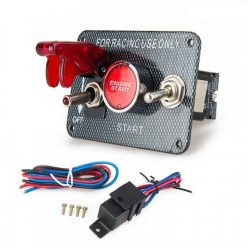
Net price: 19 €
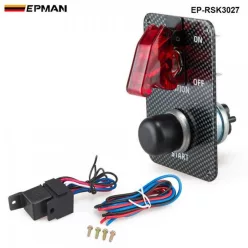
Net price: 16 €
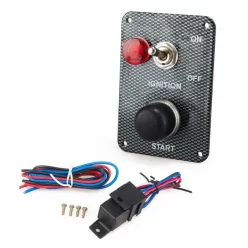
Net price: 16 €

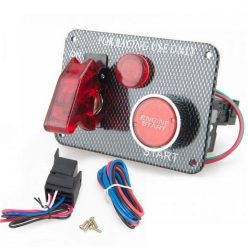

Net price: 17 €

Net price: 18 €

Net price: 16 €
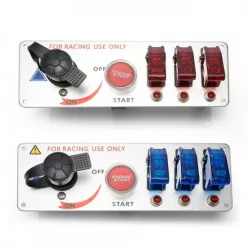
Net price: 30 €
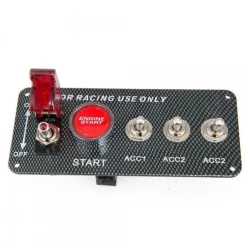
Net price: 26 €
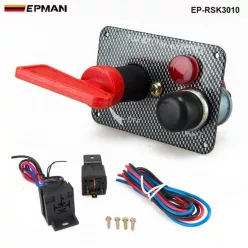
Net price: 16 €
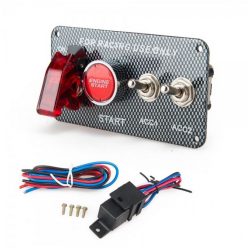
Net price: 18 €
Brief summary & key benefits
The Switch Panels & Fuse Boards category is built for clean, safe control of multiple auxiliaries—lights, fans, pumps, winches. Integrated fuse blocks and often relays keep wiring tidy, while labelled terminals and icon rockers make operation intuitive. Options span 4–12 circuits, plus dedicated engine start modules and battery test features.
Most units support both 12 V and 24 V systems, suitable for passenger cars, LCVs, 4x4s, marine and motorsport builds. Robust aluminium or glass-filled fascias resist vibration; many models provide IP sealing and LED indicators. Consistent footprints make later upgrades straightforward.
Technical Basics
Housings are typically aluminium or ABS/polycarbonate. Switches use ON-OFF or ON-OFF-ON logic, sometimes momentary actions for winches. Fusing is usually blade-type (ATO/ATC) with typical per-circuit current ratings of 10–20 A. Terminations use spade Faston lugs or screw terminals; many boards include a common bus bar for grounding.
Starter panels combine a high-current start button and master switch; diode suppression and ignition interlocks reduce misoperation. Electronic circuit controllers add resettable fuses and remote panels, simplifying troubleshooting and enabling compact layouts.
Frequent pitfalls: undersized cable, excessive shared loads, long skinny earth returns, and placing the fuse board far from the loads. Avoid them with per-branch fusing, short clean grounds, and correct conductor cross-sections.
Selection Criteria
1) Number of circuits & load — plan for today and future. Example: 6 circuits (two light bars, fogs, fan, water pump, spare). Account for running current and start-up peaks.
2) Control logic — do you need momentary for a winch, or three-position ON-OFF-ON for lighting modes? Match the panel’s switch types accordingly.
3) Fusing & relays — choose designs with per-circuit fuses; for high-draw loads use external relays or solid-state switching. In dusty/marine use, prefer sealed housings and gaskets.
4) Indication & lighting — LED status, clear legends and optional voltmeter improve safety. Avoid glare for night driving.
5) Mounting — decide between flush or surface mount. Confirm panel cut-out, hole spacing and rear clearance for wiring looms.
Installation & Maintenance
Lay out your power topology: feed the fuse board first, then branch to switches and loads. Size the cable gauge to the current (e.g., 10–15 A: 1.5–2.5 mm²), add a fuse to each branch close to the load, and route earths to a star point.
Mark the panel cut-out accurately, drill with a hole saw and deburr. Crimp terminals with a quality ratchet tool and secure with heat-shrink. For high-current winch/lighting feeds, fit a MEGA/ANL main fuse near the battery. Before commissioning, perform a loaded test and measure voltage drop; ~0.5 V or more calls for thicker cable or better earthing.
For maintenance, periodically re-torque mounting screws, verify fuse values and keep spares. Inspect for heat discolouration and soft plastics. On sealed enclosures, maintain the gasket; clean surfaces with neutral detergents only.
FAQ
Q: Can a 12 V panel run on 24 V?
A: Yes if specified by the maker; always check switch and LED ratings.
Q: What fuse size for a 15 A circuit?
A: Typically 15–20 A blade, but consider inrush and wire size.
Q: Do I need relays for a large light bar?
A: Yes—use relays or solid-state drivers so the panel switch handles only the control current.
Q: The panel LEDs are too bright at night. Solutions?
A: Use dimmed backlight feeds or panels with adjustable illumination.
Q: Where should I place the fuse board?
A: As close to the loads as practical, with the main fuse located close to the battery for protection.
