
In EPMAN Universal Fuel Pumps, you can choose between 044 Style external inline pumps and an in-tank EFI pump option, typically in the 300–450 LPH range for petrol and selected E85 use cases. If you want to compare universal pumps across multiple brands, open Fuel Pumps - Universal. Use filters (stock/price) and sorting, then confirm ports, fittings and dimensions on the product page so the pump matches your plumbing and mounting space. Select the right item and place your order.

Net price: 49 €
Net price: 41 €

Net price: 49 €
Net price: 41 €
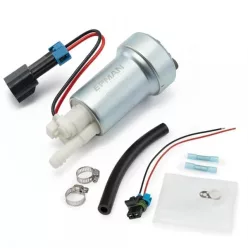
Net price: 72 €

Net price: 59 €
EPMAN Universal Fuel Pumps – 044-style external pumps and in-tank options for clearer, more consistent fuel delivery
EPMAN Universal Fuel Pumps are the right fit when you’re selecting by flow (LPH) and packaging instead of an OE part number. The range commonly includes external inline 044-style fuel pumps and an in-tank EFI pump option, with different connection styles depending on the exact item.
You may see a 300 LPH Bosch 044 alternative, a 400 LPH external EFI pump supplied with adapters, and a 450 LPH class in-tank pump with an installation kit. Always cross-check your operating pressure, ports/fittings and electrical supply requirements against the product page specifications before buying.
Technical Basics
With universal fuel pumps, headline LPH figures depend on the stated pressure point, so size the pump to your real operating pressure. On EFI setups, the complete system—lines, filters and the fuel pressure regulator—determines whether pressure stays stable under load.
External 044-type pumps commonly use a 60 mm body and metric ports such as M18×1.5 inlet and M12×1.5 outlet. Some EPMAN external EFI variants are described with AN10 inlet and AN8 outlet adapters, and may include a check-valve style outlet fitting depending on the listing.
For the in-tank EFI option, physical fitment and the outlet size matter most: the product page may specify a 10 mm (3/8") outlet and an operating range such as 2.4–6.0 bar (35–87 psi). That means you should verify tank module clearances, hose routing and wiring capacity before installation.
Quick warning: if the inlet side is restrictive, you increase cavitation risk and can lose real flow even with a high LPH-rated pump.
Selection Criteria
Start with layout: 300 LPH and 400 LPH options are typically external inline pumps, while the 450 LPH option is intended for in-tank installation. Beyond the power goal, consider whether your mounting location allows safe mounting and service access for an external pump.
Next, confirm connections: many 044-based solutions rely on M18×1.5/M12×1.5 ports with suitable fittings, while some kits provide AN10/AN8 adapters out of the box. If you need a more OE-style interface, look for a listing that specifies an 8 mm banjo fitting where relevant to your plumbing plan.
Finally, plan electrical supply: high-flow pumps need stable 12 V and good grounds, so use a relay feed and the correct fuse rating. If the product page lists current draw (A), size wiring and terminals accordingly to avoid voltage drop and reduced output.
Installation & Maintenance
For external pumps, keep the inlet well supplied and protect it with proper filtration: some listings explicitly require a 100 micron pre-filter before the pump. Mount securely, avoid tight bends, and leave room around ports for leak checks and servicing.
Prime before first start and verify every joint: O-rings and fittings must seal, and M5/M6 threaded terminals should be clean and tight. Under load, pressure fluctuation or abnormal noise is often a filter or electrical contact issue, so check those before blaming the pump.
Safety: fuel system work is fire-risk, so always depressurise, ventilate and only run the system once it is fully leak-free. As routine upkeep, re-check filters, fitting torque and ground points to keep fuel delivery consistent.
FAQ
Which EPMAN fuel pump is suitable for a Bosch 044 replacement?
Look for an 044 Style or Bosch 044 alternative listing and confirm the M18×1.5/M12×1.5 ports. Also verify body size and your fitting strategy so the pump matches both mounting and plumbing.
What does AN10 inlet / AN8 outlet mean on an external EFI pump?
It means the kit provides adapters so your plumbing can be configured as AN10 on the inlet and AN8 on the outlet. Check whether a check valve style outlet fitting is included and ensure your line sizes are consistent throughout the system.
Can I run E85 with an EPMAN universal fuel pump?
Some product pages explicitly mention E85 / ethanol-blend compatibility, while others do not, so treat each listing individually. With ethanol blends, prioritise good filtration and stable 12 V supply to reduce risk under load.
What pre-filter should I use before the external EFI pump?
Certain listings specify a 100 micron pre-filter requirement ahead of the pump. Downstream filtration is typically finer for EFI use, but your final setup should match your injectors, regulator and line sizing.
What’s the difference between the 450 LPH in-tank pump and external 044-style pumps?
The 450 LPH option is typically an in-tank pump with a defined outlet size such as 10 mm and a stated pressure range. External 044-style pumps are mounted inline and often rely on metric ports with adapter-based plumbing, so packaging and fittings drive the decision.
Filter the list to your build, verify ports and pressure figures, then choose the right EPMAN pump and complete your order.
