
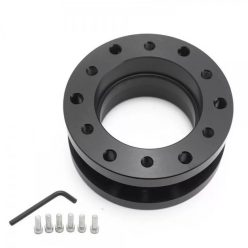
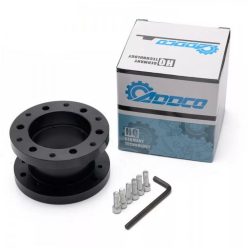
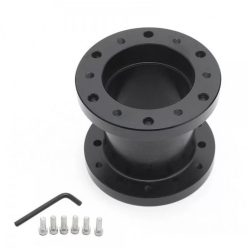
Our steering wheel spacers bring the rim closer for better ergonomics and control. Choose among multiple thicknesses and bolt patterns (6×70 mm, 6×74 mm) to fit between your wheel and hub. Precision-machined aluminium construction, clean fitment and secure clamping—ideal for road and track setups.


Net price: 86 €

Net price: 86 €
Brief summary + key benefits
Steering wheel spacers are a simple way to fine-tune reach without changing your whole hub setup. The right thickness improves ergonomics, reduces shoulder/wrist strain and can sharpen steering feedback. Our selection covers common 6×70 mm and 6×74 mm patterns in precision-machined aluminium, ensuring concentricity and clean fitment.
Technical Basics
A spacer sits between the wheel and the hub, increasing system stack height (effective offset). The typical bolt circles are 6×70 mm (MOMO/Sparco) and 6×74 mm (Nardi/Personal). Concentric bores and accurate bolt pattern placement minimise runout and vibration. Quality units use rigid aluminium plates with reinforced inserts or sleeves around the fasteners for durability.
Thickness range: roughly 10–60 mm covers most needs. Each additional millimetre changes reach, instrument visibility and stalk access. Hole styles include countersunk (for flat seating) or through-holes with washers; both aim for even clamping and reliable torque transfer under load.
Compatibility: the spacer must match both the wheel and the hub patterns. If the two differ, a pattern adapter is required—which also increases stack. Fastener diameter and length must suit the new total thickness; as a guideline, target at least one to one-and-a-half times the fastener diameter in thread engagement.
Selection Criteria
Use case: for road comfort, modest thickness often suffices; for track driving, a shorter hub plus a mid-depth spacer can provide crisper feedback. With cages, a compact offset plus a spacer can improve ingress while keeping control feel.
Bolt pattern: confirm whether your wheel is 6×70 or 6×74. The spacer must match both sides—the wheel and the hub; otherwise, add a pattern adapter (and account for extra height).
Ergonomics: too much thickness can bring the rim uncomfortably close, obscure instruments or affect stalk reach. The goal is a neutral shoulder–elbow angle with relaxed wrists and clear sight lines.
Fasteners: use quality 8.8/10.9 hardware tightened to specified torque (Nm) in a star sequence. Choose lengths that account for the added stack; use threadlocker only if the manufacturer specifies. Verify that the wheel’s back face, column shroud and horn ring do not contact at any steering angle.
Installation & Maintenance
Disconnect the battery first (especially on airbag-equipped cars). Mark the wheel centre, clean all mating faces and install the spacer between the wheel and hub. Keep mating faces dry; do not lubricate tapers/splines. Tighten bolts gradually in a star pattern and finish with a calibrated torque wrench.
After 100–200 km perform a re-torque and visual check. Watch for loosening, rubbing or any emerging play. Heavy track use or rough roads warrant more frequent inspections. Always confirm full-lock clearance and wire slack for the horn contact.
FAQ
Q: 6×70 vs 6×74—how do I choose?
A: Match your wheel’s bolt pattern; the spacer must also match the hub. Use an adapter only if patterns differ.
Q: What thickness should I pick?
A: 10–30 mm for minor reach changes, 40–60 mm for larger adjustments—verify visibility and stalk access.
Q: Do I need longer bolts?
A: Yes—added stack height requires longer hardware to maintain proper thread engagement.
Q: Will a spacer affect stiffness?
A: High-quality aluminium spacers with correct torque maintain a rigid connection; poor hardware can introduce play.
Q: Can I use a spacer with a quick release?
A: Yes—include the quick release thickness in your reach calculation to keep ergonomics and visibility in check.
