
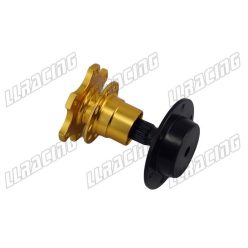
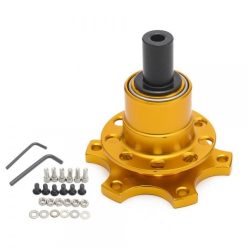
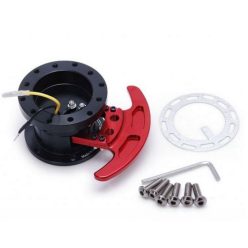
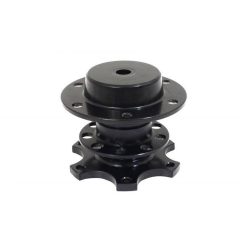
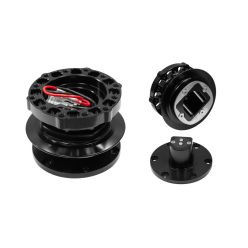
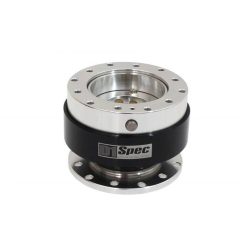
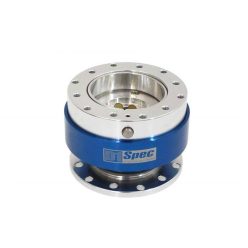
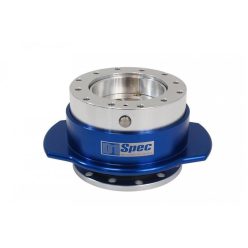
Our quick-release steering hubs let you remove the wheel in seconds for easier ingress and service. We stock 6×70 mm and 6×74 mm patterns in aluminium/steel constructions with play-free locking. Choose the right quick release type (tapered, ball-lock, hex) for your use case to ensure consistent clamping, clean fitment and reliable operation.


Net price: 21 €

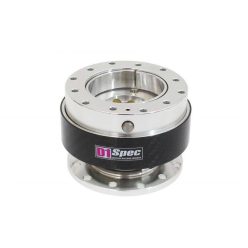
Brief summary + key benefits
Quick-release steering hubs allow one-hand wheel removal with repeatable, play-free re-engagement. The right quick release improves ingress/egress, speeds up service and preserves steering feel. With common 6×70 mm and 6×74 mm patterns and mixed aluminium/steel construction, you can optimise ergonomics and connection security for your setup.
Technical Basics
QRs sit between the wheel and the hub, using precision locking mechanisms. Popular architectures include tapered male–female couplings, ball-lock pins with spring preload, and hex/spline interfaces. The goal is near-zero play and high repeatability over many cycles. Hard-anodised bodies reduce wear; heat-treated steel pins and sleeves resist fretting and fatigue.
Patterns & compatibility: most motorsport wheels are 6×70 mm (MOMO/Sparco) or 6×74 mm (Nardi/Personal). Your QR must match the wheel and the base hub; otherwise you need a pattern adapter. Internally, the base hub matches the steering column spline, which determines stack height and reach.
Materials & tolerances: lightweight aluminium shells keep mass low near the hands, while critical load paths use hardened steel. Tight concentricity and surface finish are essential; poor tolerances cause rattle and accelerated wear.
Safety & feedback: proper designs provide clear tactile/visual confirmation when locked. Avoid lubricants on the taper/locking faces unless specified by the manufacturer. Always respect specified fastener torque (Nm) and inspect locking elements regularly.
Selection Criteria
Use case: for track/service, ball-lock or tapered systems give fast, positive engagement; for mixed road/track, prioritise repeatability and ergonomics. Compact units help when cages limit access.
Bolt pattern: verify whether your wheel is 6×70 or 6×74, and match the QR and base hub accordingly. If a QR is added to an existing setup, remember it increases effective offset.
Stack height: many QRs add 20–60 mm. Balance this with hub offset or spacers to keep stalk reach and instrument visibility optimal. Confirm full-lock clearance and steering arc.
Build quality: look for hard-anodised bodies, hardened steel pins, crisp detents and tight machining. Any perceptible play is a red flag under vibration and load.
Fasteners: use quality 8.8/10.9 hardware to the specified torque; tighten in a star pattern for even seating. Threadlocker only if the manufacturer advises it.
Installation & Maintenance
Disconnect the battery before work. Mark the OE wheel centre, install the base hub per the service manual, then bolt the QR to the hub and wheel. Keep all mating faces clean and dry; do not grease the taper/locking elements unless specified. Verify horn contact continuity and wire slack at full lock.
After initial use, perform a re-torque at 100–200 km and check for any emerging play or rubbing. Periodically clean mating faces and inspect detents/pins for wear. Any unusual sound or looseness warrants immediate inspection.
Note: suitability for public-road use may depend on local regulations. From a technical perspective, correct assembly and routine inspection are essential for safety.
FAQ
Q: 6×70 or 6×74—how do I choose?
A: Match your wheel’s pattern. MOMO/Sparco typically 6×70; Nardi/Personal often 6×74.
Q: How much play is acceptable?
A: Quality QRs feel effectively play-free. Any noticeable rattle should be addressed immediately.
Q: How much stack height do QRs add?
A: Typically 20–60 mm; this increases effective offset, so adjust seat/wheel position accordingly.
Q: Should I use threadlocker?
A: Only if the manufacturer specifies. Overuse can distort fastener torque values.
Q: Is road use allowed?
A: It depends on local rules. Regardless, correct installation and periodic checks are mandatory.
