
Plugs and Caps (AN/ORB/NPT/Metric) is for closing unused ports during assembly, pressure testing, or as a permanent blanking solution. The range includes 36 items from TURBOWORKS, DEATSCHWERKS and AEROMOTIVE, covering sizes such as AN3–AN12, 1/8 NPT–3/8 NPT and M12x1.5, with multiple O-ring options.
For other fitting families, go back to Fittings and Threaded Adapters. Use filters (Size, Brand, stock), sort the list, then open the product page to confirm whether it seals by 37° flare, ORB or NPT. Choose the compatible plug/cap and place your order.

Net price: 16 €


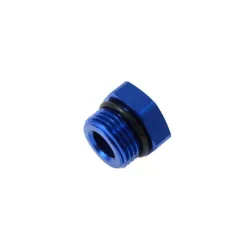


Plugs and Caps (AN/ORB/NPT/Metric) – close ports properly for cleaner plumbing, safer testing and leak-free blanking
Plugs and Caps (AN/ORB/NPT/Metric) is the right category when you need to seal an unused fitting, block a spare port, or protect a connection during build-up and testing. You can use them as a temporary protective cap, or as a permanent blanking plug once a system has been simplified. The selection lists 36 items, with TURBOWORKS as the main brand alongside DEATSCHWERKS and AEROMOTIVE.
Common use cases include fuel and oil plumbing where a spare sensor port or service take-off is no longer needed, or where you want to cap an AN line end during pressure testing. The key is not just “it threads in”, but that the plug/cap matches the correct sealing method: ORB, NPT or 37° flare.
Size filters cover AN3–AN12, plus 1/8 NPT, 1/4 NPT, 3/8 NPT and M12x1.5, with several O-ring designs. That makes this a practical place to grab a threaded plug, flare cap or an ORB plug when you want a tidy, serviceable finish.
Technical Basics
AN connections typically seal on a 37° flare seat, so an AN cap or AN plug depends on clean, undamaged sealing faces rather than thread sealant. If a capped joint weeps, a nicked seat or mismatched geometry is a common cause. Treat sealing faces as precision surfaces.
ORB (O-ring boss) ports seal via an O-ring, so an ORB port plug is only as good as the ring condition and how it sits. One short warning: a pinched or hardened O-ring can leak even if the thread feels “tight”. Always check the O-ring groove and mating face.
NPT is a tapered thread and often seals on the thread itself, while metric ports (for example M12x1.5) may seal by O-ring, washer or a defined seat depending on the component. Correct thread identification and sealing style are more important than adding extra torque. If you are unsure, confirm the port spec before committing.
Selection Criteria
First, identify what you are closing: an AN flare interface, an ORB port, or an NPT threaded hole. The size must match the receiving side (for example AN6 or 1/8 NPT), and you also need the correct male/female orientation for a true seal.
Second, decide on use: for temporary work a simple cap can be fine, while a permanent blanking point usually benefits from a proper O-ring design where applicable. If packaging is tight, prioritise spanner access and a body shape that can be tightened without damaging adjacent hoses. Brand choice (for example DEATSCHWERKS vs TURBOWORKS) should follow interface and sealing requirements first.
Third, consider operating conditions: fuel and oil systems see vibration and heat cycles, so choose a plug/cap type that matches the sealing method and can be re-checked easily. A clean, correctly matched blanking plug usually outperforms improvised adapter stacks. When in doubt, verify the product page notes such as “with O-ring” or “flare”.
Installation & Maintenance
Clean threads and sealing faces, then start the thread by hand to avoid cross-threading. On AN fittings, protect the 37° flare seat; on ORB plugs, confirm the O-ring is seated correctly and not twisted. This prevents “mystery weeps” after the first heat cycle.
For NPT plugs, use thread sealant only where the design expects it and keep excess material out of the flow path. For M12x1.5 and other metric ports, make sure you understand whether sealing is by O-ring or a face/washer. After assembly, pressure-test and re-check once the system is hot.
If a cap is removed frequently during servicing, treat the O-ring as a wear item and replace it if it is cut, flattened or hardened. Repeated “tighten harder” is rarely the correct fix; matching the sealing method and keeping surfaces clean is. A quick inspection after track use can prevent small leaks from becoming a bigger mess.
FAQ
What’s the difference between an AN cap and an ORB port plug?
An AN cap typically seals on a 37° flare seat, while an ORB port plug seals with an O-ring. They are not interchangeable even if the thread seems close. Always match the plug/cap to the port’s sealing method.
How can I tell if my port is NPT or metric?
NPT is usually tapered, while metric threads are defined by diameter and pitch (for example M12x1.5). The safest check is the component specification or accurate thread measurement. Avoid forcing near-match threads, as damaged ports can leak permanently.
Do I need thread sealant on plugs?
Not on AN flare joints, because they seal at the 37° seat, and not on ORB joints, because the O-ring seals. Thread sealant is mainly relevant to NPT plugs when the design seals on the thread. Follow the sealing logic of the port, not a one-size-fits-all approach.
Which size should I choose: AN6, AN8 or AN10?
Match the size to the receiving fitting: an AN8 port needs an AN8 cap/plug. Also confirm whether you need a cap (female) or a plug (male) for the specific end you are closing. Checking the product page interface description prevents mismatches.
Why does an O-ring cap or plug still leak?
Most leaks come from a damaged or pinched O-ring, or contamination on the sealing face. Remove it, clean the mating surfaces, and inspect the O-ring for cuts or flattening. Replace the O-ring if it is not in good condition, rather than increasing torque.
Filter by interface and size, confirm the sealing method on the product page, and order the plug or cap that matches your ports.
