
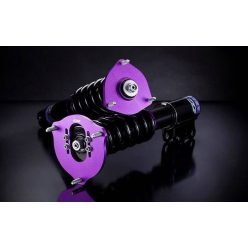
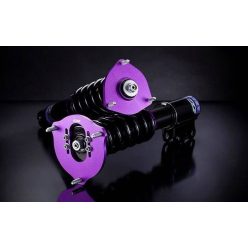
Lancia – D2 Racing Street suspension kits are road-focused, height-adjustable spring–damper packages for Delta, Ypsilon, Lybra/Thesis and more. Threaded bodies with refined damping improve cornering stability and steering feel while preserving daily comfort. Verify axle loads, body/drivetrain and stay within the approved adjustment range.
Net price: 1 004 €
Net price: 1 004 €

Net price: 1 004 €

Net price: 1 004 €
Brief summary & key benefits
Lancia – D2 Racing Street kits provide calmer body control, precise ride-height tuning and consistent damping compared with stock, while keeping everyday comfort intact. A measured drop lowers the centre of gravity, trims pitch/roll and clarifies steering feedback without turning the car into a track-only setup. Application-specific damping, quality bushings and anti-corrosion finishes support long-term durability across seasons.
Technical Basics
Each package combines gas-charged dampers with vehicle-specific steel springs. A threaded body with locking collars allows per-axle height changes so you can balance stance and geometry. Depending on application, springs may be linear for direct feedback or dual-rate/progressive to improve small-bump compliance while maintaining support under load. Heat-stable oil keeps damping consistent during temperature swings; dust boots and seals protect sliding parts. Exterior components use anti-corrosion coatings for winter resilience.
Platform notes: many Delta and Ypsilon variants pair a front MacPherson strut with a rear torsion beam. The latter limits rear camber adjustment, so alignment tuning focuses on the front axle (sensible negative camber and appropriate toe). Larger saloons like Lybra/Thesis carry more mass and wheelbase, shifting axle loads and demanding careful preservation of bump travel. Excessive lowering on any platform narrows alignment latitude, reduces travel and can push control-arm angles into unfavourable ranges.
Electronics (ESC/TC) work best when mechanical balance is sound. Too-low front height can make turn-in nervous; too-soft rear support increases understeer. Start near the mid-range height within the manufacturer’s approved window, then iterate in small, documented steps to suit your roads and tyres.
Selection Criteria
Use case — For commuting and mixed B-roads, begin near a mid-range height to retain travel, comfort and alignment freedom. For occasional events, lower slightly only if wheel-arch clearance and bump stops remain safe; confirm kerb/ramp access in everyday routes.
Body/drivetrain — Most Lancia models are FWD and front-heavy. Prioritise front camber/toe targets that balance turn-in with tyre life. If your variant features heavier powertrains or AWD, expect higher mass and different axle loads; a slightly higher baseline height and modest rear rebound often preserve travel and composure.
Tyres & wheels — Larger wheels and short sidewalls look sharp but reduce compliance and raise bottom-out risk. On street tyres, moderate camber with a middle ride height protects tyre life and keeps steering linear. Stickier tyres can justify a touch firmer rebound if road quality allows.
Brakes & unsprung mass — Bigger brake/wheel packages add unsprung mass and thermal load. Respond with slightly more rebound control and avoid extreme camber that accelerates inner shoulder wear. Re-check arch clearances at full lock and under compression after any height change.
Loads & comfort — Regular passengers or luggage justify a little more rear ride height to preserve travel and braking attitude. On long undulations, a hint more rebound calms body motion without hurting comfort.
Everyday usability — Ultra-low stances increase NVH and reduce travel. For mixed roads, a conservative stance with balanced toe and sensible camber keeps the chassis composed over crests and compressions and protects underbody components.
Installation & Maintenance
Have a qualified shop install the kit. Clean threads and apply light anti-seize; torque fasteners to factory specs and preload rubber bushes at ride height. After a shakedown drive, re-torque and perform a four-wheel alignment (camber/toe/caster). Record a written baseline of height/damping/camber so you can revert quickly after experiments or tyre changes.
For longevity, periodically wash threaded sections, refresh anti-corrosion spray and verify that lock collars have not moved. Any knocking, oil mist or pogo-like behaviour warrants inspection of dampers, top mounts and mounting points. After large temperature swings or a switch to wider wheels, re-check rebound and height to keep balance neutral.
FAQ
Q: How low can I go for daily use?
A: Stay within the manufacturer’s approved range and start near mid-height to preserve travel and alignment latitude.
Q: Is an alignment required after installation?
A: Yes — lowering changes geometry; perform a full four-wheel alignment after fitting and after any height change.
Q: Do torsion-beam rears limit alignment?
A: Yes — rear camber is largely fixed; use front camber and toe to balance handling and tyre wear.
Q: Will large wheels reduce comfort?
A: Short sidewalls cut compliance; consider a slightly higher ride height and measured damping for daily roads.
Q: What baseline settings should I start with?
A: Mid-height, moderate front camber and the recommended damping baseline; adjust in small steps and document changes.
