
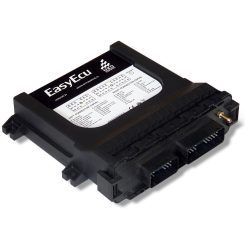
Our EasyEcu ECUs are compact standalone controllers offering flexible mapping, high-rate logging and CAN integration. They support wideband-based closed-loop fuelling, drive-by-wire control and safety limits for AFR/EGT/oil pressure. A smart choice for road–track builds that demand steady idle, reliable starts and repeatable power in a tidy package.

Brief summary & key benefits
EasyEcu ECUs pack full engine management into a compact unit with flexible mapping, rich I/O and high-rate logging. CAN connectivity streamlines integration with dashes, wideband modules and data systems, while AFR/EGT/oil safeguards intervene under fault to protect the engine across practice, quali and race.
Technical Basics
The controllers decode common crank/cam trigger patterns for accurate timing. Typical features include wideband-driven closed-loop fuelling, drive-by-wire throttle control, idle strategies, optional flex-fuel sensing, and multi-table ignition/fuel maps. Output topology (low-side/high-side), coil drive type (logic or inductive) and sequential injection support must match your hardware. High-sample logging plus data-led tuning shortens diagnosis and improves repeatability.
Tuning software enables live table edits, quick map switching, start and warm-up enrichments and temperature-based corrections. Clean behaviour depends on solid grounds, short power runs and shielded sensor routing, especially on boosted or high-compression engines where noise margins are small.
Selection Criteria
List required I/O: injector and ignition outputs, sensors (MAP, IAT, CLT, TPS, EGT, wideband) and auxiliaries (fans, pumps, boost solenoid). Verify compatibility with crank/cam patterns (e.g., 60-2), DBW throttles and loom connectors. For forced induction, prioritise staged boost control, AFR/EGT-based protection and robust fuel-pressure monitoring. Evaluate the software ecosystem—documentation, log viewer and reliable firmware updates—as it directly affects setup time and reliability.
Use cases: road–track builds target stable idle, clean signals and good cold-start. Time-attack cars value repeatable power and heat management; drift applications benefit from quick map switching and torque shaping. With factory looms, an adapter harness eases integration; bespoke looms offer maximum robustness, shielding and strain relief in harsh environments.
Installation & Maintenance
Work on an isolated system. Keep power/ground paths short with direct battery and clean chassis grounds. Route sensor wiring away from ignition/high-current paths; use shielding and twisted pairs for sensitive lines. After installation, verify crank/cam sync, sensor sanity and supply stability. Start with conservative limits (boost, EGT, oil pressure) and iterate using logged data across sessions. Re-check fastener torque and grounds after initial heat cycles and vibration.
Maintenance: back up calibrations regularly, follow firmware procedures and review trends (AFR, knock, fuel pressure). Observe wideband heater guidelines and inspect the exhaust for leaks that skew readings. Periodically check loom retention, connector seals and any signs of abrasion or heat damage.
FAQ
Q: Why choose EasyEcu over an OEM ECU?
A: More tuning control, richer I/O and logging for modified engines—when installed and calibrated correctly.
Q: Do I need a wideband O₂ sensor?
A: Yes—for closed-loop fuelling and to enable effective safety strategies.
Q: Can I reuse the factory loom?
A: An adapter harness is common; custom looms suit complex I/O or harsher duty.
Q: Which trigger patterns are supported?
A: Common patterns such as 60-2/36-1 are typical; confirm against your engine’s pickup.
Q: How long does tuning take?
A: It depends on engine spec and I/O complexity; tune progressively using logs and conservative limits.
