
Our digital dash displays cover road and motorsport needs with bright TFT screens, configurable shift lights, CAN/OBD-II integration and optional logging. Leading brands include AEM, AiM, ECUMASTER and Haltech. Choose by display size, connectivity and mounting, and always verify ECU compatibility and required sensors before purchase.
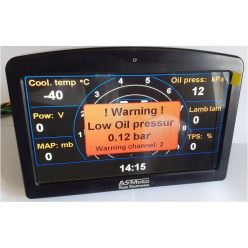

Net price: 1 672 €

Net price: 1 278 €
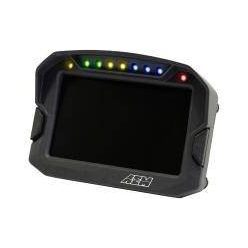
Net price: 1 713 €

Net price: 1 913 €

Net price: 2 435 €
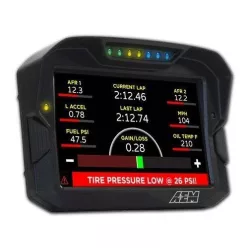
Net price: 2 348 €
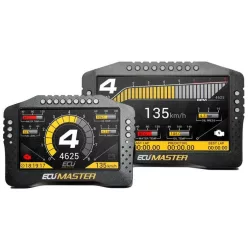
Net price: 1 297 €
Net price: 1 675 €
Brief summary + key benefits
Digital dash displays replace analogue gauges with bright, configurable screens. Key benefits include custom layouts, warnings and alarms, integrated data logging and robust CAN-based communications. Good units remain readable in full sun, feature programmable LED shift lights and connect to a wide range of ECUs. Options span compact 5–6″ to 7–10″ panels with steering wheel, column or flush-mount brackets.
Technical Basics
Most models use high-brightness TFT/IPS panels (around 800–1200 nits). Communication is via CAN (250–1000 kbit/s) and/or OBD-II; many support multiple CAN channels to add sensors through a CAN expander. Common extras include built-in GPS for lap timing and track mapping, IMU for acceleration/tilt, and on-board logger storage (4–32 GB or SD). Software typically offers templates, widgets and fully configurable alerts for vital parameters such as oil pressure, coolant temp and lambda.
Compatibility depends on your ECU. Some dashes provide direct ECU protocol profiles (e.g., popular aftermarket brands), while others require a custom CAN definition. Frequent pitfalls are missing 120 Ω termination, ground loops and undersized power wiring. Aim for a clean 9–16 V supply, dedicated fuse and shielded signal lines.
Selection Criteria
Screen size & resolution: For road cars, 5–7″ strikes a balance; for competition, 7–10″ displays more channels. Higher resolution enables sharper graphics and denser layouts. Consider brightness and anti-glare coatings for open-cockpit use.
Connectivity & expandability: Check the number of CAN channels, OBD-II support, and available accessories (GPS, camera trigger, analogue inputs). If you need lap timing and video overlay, pick a model with integrated GPS and logging.
Software & customisation: Look for easy layout editing, adjustable shift-light curves, multiple profiles (road/track) and exportable CSV/engineering formats for analysis.
Mounting & durability: Verify bracket options (wheel centre, column clamp, dash pod), IP sealing and cable routing. In high-vibration race cars, a rigid mount and quick-disconnect cabling helps.
Budget planning: Entry level covers basic display; mid-range adds logger and GPS; top tier brings larger screens and advanced analytics. Include sensors, connectors and installation time in your total cost.
Installation & Maintenance
Start with power: fused +12 V feed, clean ground and noise-free earthing. Keep twisted CAN pairs short, verify total bus 120 Ω termination, and avoid star topologies. Position the display so critical info sits in your peripheral vision and the LED shift-light is unobstructed. On the shakedown run, validate sensor calibration and alarm thresholds.
For upkeep, apply regular firmware updates, offload logs, and protect connectors with contact cleaner. After track days, check mounts and back up layouts/profiles. If you notice fogging, inspect IP seals and cable glands.
FAQ
How does the dash read ECU data?
Via OBD-II or CAN. Many dashes include ready-made ECU profiles; otherwise upload a custom CAN map.
Do I still need a standalone logger?
Not always. Many dashes include integrated data logging; for high sample rates choose models with larger storage.
What screen size suits daily driving?
5–7″ is compact yet readable; track cars benefit from 7–10″.
Is it road legal?
Usually yes, but check local regulations and ensure the unit doesn’t obstruct your view.
Why are my values dropping out?
Common causes are missing termination, poor grounding or incorrect CAN settings. Recheck wiring and protocol.
