
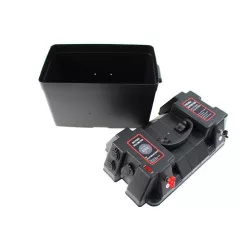
Our Battery Boxes & Enclosures keep the battery secure, tidy and protected in the cabin or boot. Choose from sealed or vented designs, universal trays, cable glands and hold-downs. The right enclosure reduces risks from movement, spills and shorts while delivering a clean, professional installation.


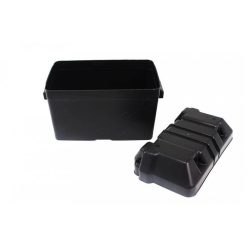

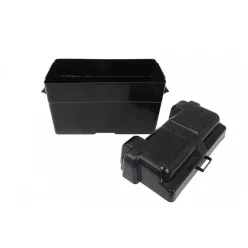
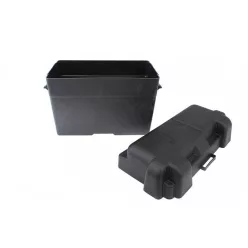
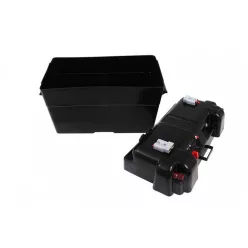
Brief summary + key benefits
Battery Boxes & Enclosures provide secure mounting, mechanical protection and isolation. A robust tray and hold-down prevent movement, safeguard terminals and reduce short-circuit risk. Sealed housings with vent ports route gases outside the cabin, while vented designs prioritise access and low mass. The result is tidy packaging, improved safety and easier servicing on road and track.
Technical Basics
Common materials are ABS/polypropylene (acid-resistant, impact-tough) and aluminium (light, stiff). Enclosures often include cable glands for positive/negative leads and a vent spigot. Lids secure via screws or strap clamps designed to resist vibration. Internal pads and full-footprint support spread loads to protect the case.
Mounting points should use threaded inserts or through-bolts with large washers to avoid panel deformation. Fit an insulating cap over the positive terminal and protect looms with spiral wrap or braid. For metal boxes, durable finishes (anodising/powder coat) extend life and keep the install neat.
When located in the cabin, route the enclosure’s vent hose to the exterior. Rubber gaskets and strain-relieved glands keep fumes and dust out. Trays should pair with a robust tie-down and base plate; keep bolt patterns symmetric to distribute clamping force.
Selection Criteria
Placement: cabin, boot or engine bay? In-cabin installs favour sealed, vented boxes; in the boot, space and fixing options guide the choice. Engine bays demand heat and spray resistance and attention to IP protection.
Size & compatibility: measure the battery footprint and height; leave clearance for terminals and cable egress. A correctly sized box provides full-area support rather than point loading.
Material & mass: ABS/PP is light and resistant; aluminium is stiffer and more heat-tolerant. For track work choose rigid mounts with rivnuts; for daily use, prefer a quickly removable lid.
Accessories: cable glands, vent hose, anti-slip pads, hold-down strap and base plate. Use a positive terminal cap; protect looms with edge guards and clamps.
Aesthetics & service: black or anodised finish blends with interiors; ensure the lid opens easily for testing or replacement.
Installation & Maintenance
Disconnect the battery. Mount the box on a flat, reinforced surface using locking nuts and large washers. Route the vent line to the outside and seal bulkhead penetrations. Confirm the strap clears corners and terminals and that cables aren’t under tension.
In service, periodically check fastener torque, gland sealing and vent hose condition. After wet use or washing, dry the area thoroughly. Replace the box if cracks or deformation appear—the safety margin matters more than cosmetics.
FAQ
Q: Sealed or vented box?
A: In-cabin installs should use a sealed, externally vented box; in the boot, choose based on access and mounting points.
Q: Do I still need a hold-down strap?
A: Yes—a rigid tray plus hold-down minimises movement and cable stress.
Q: What accessories are recommended?
A: Cable glands, vent hose, anti-slip pads and a positive terminal cap.
Q: Can I mount it in the cabin?
A: Yes, with a sealed, vented enclosure and reinforced fixing points.
Q: What maintenance is required?
A: Periodic re-torque, gasket and vent checks, and neutral cleaner for surfaces.
