
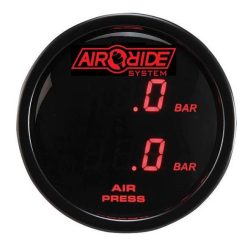
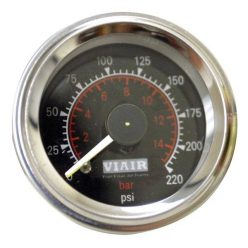
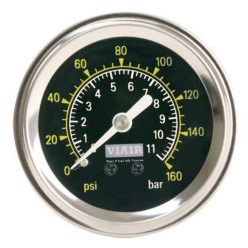
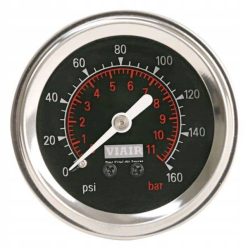
The Airride Gauges and Meters category brings together digital and analogue manometers designed to monitor tank and circuit pressures in your airride system. MTUNING digital DUAL gauges and VIAIR analogue units let you watch one or two circuits at a glance, with illuminated faces for easy night-time reading. A well-placed airride pressure gauge is not just a styling touch – it is a key diagnostic tool for keeping your air suspension healthy.
Airride gauges and meters – precise feedback from your system
Airride Gauges and Meters give real-time insight into tank and circuit pressures so you always know what is happening inside your suspension. This category includes MTUNING digital DUAL manometers and VIAIR analogue gauges in various sizes and layouts to suit different dashboards. A good pressure gauge does more than look cool – it helps you spot leaks, misadjustments and load issues before they become serious. When you can see both front and rear pressures clearly, dialling in a comfortable and safe ride height becomes much easier.
Technical Basics
Most airride gauges work within 0–10 bar or 0–200 psi, which comfortably covers typical passenger car air suspension pressures. VIAIR analogue gauges use a mechanical Bourdon-tube mechanism that has been proven for decades in automotive and industrial applications. Digital DUAL gauges rely on pressure senders that convert system pressure into an electrical signal, offering stable, flicker-free readings. It is important that the gauge range and thread type – such as 1/8" NPT or 1/5" – match the existing ports and fittings on your system.
Gauge backlighting and power draw from the vehicle’s 12 V supply also matter. Illuminated faces and LED displays allow clear reading at night, so wiring is usually tied to the ignition or lighting circuit. You can choose single-circuit gauges or dual gauges that show two pressures in one 52 mm housing – ideal for monitoring both axles without cluttering the dashboard. Warning: consistently running a system near or above the top of the gauge scale can reduce accuracy and shorten gauge life.
Selection Criteria
When selecting an airride gauge, decide first between analogue and digital. Analogue gauges offer a classic look and allow you to judge trends at a glance, while digital units show precise numeric values and often combine multiple functions. If you want to monitor both front and rear, a dual manometer is a neat solution, providing two readings in a single slot. For show builds, face colour, bezel style and backlight tone are part of the overall interior design, whereas daily drivers usually prioritise legibility and durability.
Mounting location is another key factor. You can use A-pillar pods, centre console panels or discreet under-dash mounts depending on how visible you want the gauge to be. Wiring is simpler if the gauge taps pressure near the tank or valve block and only signal wires run to the cabin, but mechanical gauges may use direct air lines instead. Decide whether you need continuous display of tank pressure, axle pressures or both before choosing your layout. Warning: a gauge mounted where you rarely look at it provides little benefit, no matter how accurate it is.
Installation & Maintenance
When installing Airride gauges and meters, focus on vibration-resistant mounting and good visibility. Screw-in analogue VIAIR gauges should be sealed with appropriate thread sealant (such as PTFE tape or paste), taking care not to block the port. Digital units require their pressure sender to be mounted in an accessible area of the system, with wiring securely routed and protected from chafing. Follow the manufacturer’s wiring diagram for +12 V, ground and illumination, and use the recommended fuse rating.
For maintenance, occasionally check connections for leaks and ensure gauge lenses remain clean and scratch-free. If pointers flutter or digital displays show unstable readings, inspect both the electrical supply and the sender connections for faults. Cabin-mounted gauges usually need little attention, but the plumbing and wiring behind them can loosen over time due to vibration. Warning: relying on a faulty pressure gauge can be worse than having none at all – always investigate suspicious readings before continuing normal use.
FAQ
What pressure range should my airride gauge cover?
For most airride systems, a 0–10 bar or 0–200 psi gauge is more than sufficient. The upper limit should be higher than your maximum working tank pressure so the gauge is not constantly at the end of its scale. However, an excessively high range reduces resolution and makes small changes harder to see.
Is one gauge enough, or do I need front and rear readings?
A single tank pressure gauge tells you how much air reserve you have but does not show axle pressures. If you want precise control over ride height and vehicle rake, monitoring at least front and rear pressures is recommended. A dual gauge provides this information without occupying multiple mounting positions.
Which is better for airride – analogue or digital gauges?
Analogue gauges offer a traditional look and make it easy to notice quick changes at a glance, which some drivers prefer. Digital displays provide exact numeric values and can be easier to integrate into modern interiors. Both styles can be reliable when sourced from reputable manufacturers, so the decision mainly comes down to style and reading preference.
Where should I mount my airride gauge inside the car?
Ideally the gauge should sit within your natural line of sight but not block critical instruments. A-pillar pods, central vents or console-mounted panels are common solutions. The key is being able to read the gauge quickly while driving without taking your eyes off the road for too long.
Can I run more than one gauge on the same airride system?
Yes, a single airride system can support multiple gauges – for example one for the tank and a dual unit for the axles. Just be mindful that each additional connection means more plumbing and potential leak points. Careful planning keeps the layout informative without becoming cluttered or unreliable.
