Expert customer service available Monday to Friday, 8:00 AM – 4:00 PM via e-mail at INFO@LLRACING.EU .

ACL Race HX bearings: when HX beats Race H (Std), and how to choose the right oil clearance

ACL Race HX bearings: when HX beats Race H (Std), and how to choose the right oil clearance

ACL Race HX bearings are designed to give extra oil clearance compared to the standard Race H (Std) set—typically about +0.001" (0.025 mm) on a standard-size shaft. That can help maintain a stable oil film and heat control in hard-use engines, but only if the final clearance is verified by measurement. Pick HX blindly and you may trade safety margin for low hot oil pressure or faster wear.

This guide is for builders and enthusiasts who want a correct, repeatable way to decide: what HX really changes, when it’s justified (track, drift, high oil temps), how clearance “grades” can be tuned, and which myths cause the most expensive mistakes.

06/06/2024 11:53 LLRacing

Choosing between ACL Race H (Std) and HX is not a “better vs worse” question. It’s a clearance strategy question. The bearing label is only the starting point—your real-world result depends on crank journal size, housing bore size, alignment, temperature, oil viscosity, and how the engine is used. If you treat HX as a universal upgrade, you can accidentally create a setup that looks fine cold, then suffers when hot.

What are ACL Race H (Standard) bearings?

ACL Race H (Std) is the baseline “Race” sizing option. Builders typically start here when they want a predictable combination of stable oil pressure and oil film behavior for performance street and many motorsport builds. In practice, Race H (Std) often makes sense when your measured clearances land in your target window without needing extra “room” for heat and sustained load.

Important point: the bearing itself does not “create” a fixed clearance. The final oil clearance is the result of your crank journals, your housing bores, and the bearing set installed and torqued in place.

What are ACL Race HX bearings?

ACL Race HX bearings are the “X” version of the Race H set. The “X” indicates extra oil clearance on a standard-size shaft compared to the H-STD set. As a widely used guideline, HX provides about +0.001" (0.025 mm) additional clearance versus H-STD, because the HX shells are typically 0.0005" (0.013 mm) thinner per shell. In all other practical respects, the HX set is intended to be the same concept—just a different clearance option.

That extra clearance can be valuable when you need more oil film margin at operating temperature, but it must be chosen with the full system in mind: oil temperature control, pump capacity, viscosity choice, and the expected duty cycle.

The difference in one clean sentence

Race H (Std) is the baseline Race clearance option; ACL Race HX bearings are the same idea with added clearance when your measurements and usage justify it.

When should you use HX?

HX is typically justified when the engine will see sustained heat and load, or when your measurements show that Race H (Std) is simply too tight for your target clearance. Common scenarios:

  • Track days, time attack, circuit racing: long high-RPM periods where oil temperature climbs and stays high.
  • Drift: repeated high load and rapid transitions, often with elevated oil temperature.
  • High specific output builds: boosted engines, aggressive ignition, big cylinder pressure, and heavy bearing loading.
  • Measured clearance is too tight with H-STD: HX is a controlled way to open the window—if hot oil pressure stays healthy.

HX is not a shortcut for bad geometry. If you have bore distortion, crank taper/out-of-round, or alignment issues, the “extra clearance” label won’t save you—those problems must be corrected first.

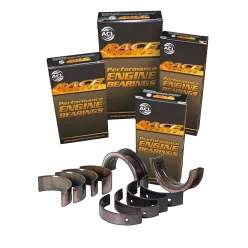
ACL Race Bearings

A key detail many people miss: clearance “grades” in 0.0005" steps

Because HX shells are commonly thinner by 0.0005" per half, mixing a standard shell with an HX shell can create a half-step change in clearance. In other words:

  • Using one HX shell + one H-STD shell can add about +0.0005" (0.013 mm) compared to two H-STD shells.
  • Using two HX shells can add about +0.001" (0.025 mm) compared to two H-STD shells.

This is powerful for precise builds, but it demands accurate measurement. Mixing shells should never be done “to try it and see.” You document every journal, every housing bore, and every assembled clearance.

How to choose: measurement-first decision process

If you want the correct answer for your engine, follow a process you can repeat and verify. This is the most reliable logic for choosing between H (Std) and HX.

1) Measure crank journals correctly

  • Use a micrometer and measure each journal in multiple places.
  • Look for taper and out-of-round. These can create tight spots even if the “average” number looks fine.
  • Inspect the surface finish: scoring or heat marks often tell you why a previous set failed.

2) Measure housing bores (block mains / rod big ends)

  • Use a bore gauge with the fasteners torqued as in final assembly.
  • Check for distortion and alignment issues. A distorted housing bore can squeeze clearance and kill an oil film at high temperature.

3) Set a target clearance based on how the engine will be used

  • Street performance typically needs stable pressure at idle and during cold starts.
  • Track/drift builds often need extra margin at high oil temperature.
  • Your oil viscosity and your oil temperature strategy matter as much as the bearing choice.

4) Decide: H (Std), HX, or a controlled half-step

  • If H (Std) hits the target, stay with it.
  • If H (Std) is too tight, consider ACL Race HX bearings—but verify hot pressure expectations.
  • If you need a very small adjustment, consider a 0.0005" half-step by mixing shells, only with full documentation.

Benefits of HX—and the trade-offs you must accept

What HX can improve

  • Oil film stability under sustained load and RPM.
  • Heat management through increased oil flow around the bearing.
  • Operating margin when temperatures push a tight setup into risky territory.

What can go wrong if you open clearance too far

  • Lower hot oil pressure, especially at idle.
  • Noise and harsher load transitions in some engines.
  • Accelerated wear in low-speed regimes if the film doesn’t build as intended.

That’s why HX should be chosen for a reason: measured tightness, sustained high temperature, or an engine plan that truly needs the margin.

Common myths and costly mistakes

  • Myth: “HX is stronger.” – HX is mainly about extra clearance, not an automatic strength upgrade.
  • Myth: “Polishing a crank ‘reduces diameter’, so you need HX.” – Surface polishing is not a reliable clearance strategy. If journals are truly undersize, you typically choose the correct undersize bearing first. HX is for clearance tuning on a standard-size shaft concept.
  • Mistake: guessing clearance from “typical numbers.” – Your engine may not match those assumptions. Measure and document.
  • Mistake: ignoring oil temperature. – Hot oil is thinner oil. If you don’t control oil temperature, clearance choice becomes a moving target.

Pre-assembly checklist (quick but serious)

  • Cleanliness: oil passages, bearing seats, and fasteners are spotless.
  • Crank condition: correct surface finish, no scoring, no heat marks.
  • Documented clearances: every journal position recorded, not “close enough”.
  • Oiling system health: pump, pickup, seals, and filtration verified.
  • First start discipline: ensure oil pressure builds quickly and monitor temperatures immediately.

FAQ

Can ACL Race HX bearings be used on the street?

Yes, if measurements show HX is needed to hit the correct clearance and you still maintain healthy hot oil pressure. Don’t choose HX blindly for a street car.

Does HX always fix bearing issues on hard-use engines?

No. HX helps only when the problem is truly insufficient clearance margin. If alignment, housing bore distortion, oil temperature, or oiling system problems exist, HX alone won’t fix them.

Is mixing H-STD and HX-STD shells a good idea?

It can be a precise way to tune clearance in 0.0005" steps, but only with accurate measurement and a clear target. If you can’t document it, don’t do it.

What’s the simplest safe rule?

Choose the bearing option that hits your measured target clearance for your real oil temperature and usage—not what “usually works” for someone else.

Conclusion: when HX beats Race H (Std)

ACL Race HX bearings are the right tool when you need extra oil clearance—most commonly for high-temperature, high-load, sustained hard use, or when H-STD measures too tight for your target window. If H (Std) already lands in the correct range and provides stable hot pressure, HX may add risk without benefit. Build decisions should be made with measured data, not guesses.

Related categories to explore

Check the related categories on the site and choose your bearing option from measured clearances—that’s how you keep performance and reliability on the same team.