
The Wilwood brake pads category brings together Smart Pad and PolyMatrix compounds for fast road, track day and full competition use. Street-oriented mixes such as BP-10 and BP-20 suit high-performance road and club track cars, while PolyMatrix A, B and H compounds cover everything from weekly oval racing to long-distance road course events. These pads are engineered for stable friction, firm pedal feel and predictable modulation when the brakes are repeatedly pushed to their limits.
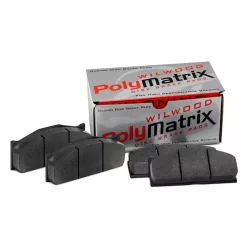
Wilwood brake pads for street, track day and racing
The Wilwood brake pads range is designed to support applications from powerful street cars to dedicated race machinery. Wilwood divides its pad line into several families: Smart Pad compounds like BP-10 and BP-20 focus on high-performance street and mixed use, while PolyMatrix A, B and H compounds target competition. BP-10 is a medium friction, low dust and low noise high-performance street pad, developed to outperform standard OE replacement materials without sacrificing drivability. BP-20 builds on this with a wider temperature range, higher effective friction and improved fade resistance, making it a baseline choice for track-oriented street cars. :contentReference[oaicite:15]{index=15}
The PolyMatrix line is aimed squarely at racing. PolyMatrix A is described by Wilwood as an “ultimate friction” material for severe-duty, extended high temperature braking, with the highest friction torque over a broad range, suitable for iron, steel or titanium rotors. PolyMatrix B is a medium-high friction compound with very versatile characteristics, widely used in weekly asphalt racing and severe-duty dirt track applications thanks to its high friction values, low rotor abrasion and minimal warm-up requirements. :contentReference[oaicite:16]{index=16} PolyMatrix H delivers a medium-to-high torque curve with long wear at sustained high temperatures, intended as a race-only compound for hard braking ovals, road courses and endurance use. :contentReference[oaicite:17]{index=17}
Technical Basics
Wilwood brake pads are defined by their friction level, temperature range and compatibility with different rotor materials. Smart Pad BP-10 is a medium friction pad with gradual response, low wear rate on iron rotors and reduced dust and noise, explicitly marketed as a high-performance street compound that remains street-legal. BP-20 is also a medium friction pad but with the highest effective temperature range in the medium group; it offers smooth engagement, increasing friction with temperature and a medium wear rate at high heat, designed as a street/track compound with improved friction over BP-10. :contentReference[oaicite:18]{index=18}
The PolyMatrix A, B and H compounds are semi-metallic race materials that stay essentially incompressible under load, giving a short, firm pedal and precise modulation. PolyMatrix A provides very high friction across a wide temperature window, ideal for severe-duty, extended high-temperature braking on iron, steel or titanium discs. :contentReference[oaicite:19]{index=19} PolyMatrix B is tuned for medium-high friction with smooth engagement, quick clean release and low rotor abrasion, which helps maintain disc life in weekly racing. PolyMatrix H delivers a medium-to-high torque curve with immediate, predictable engagement and very long wear in sustained high-heat conditions, making it suitable for trail braking and “touch and go” circuits, but it is race-only and not intended for public roads. :contentReference[oaicite:20]{index=20}
Selection Criteria
Selecting the right Wilwood brake pad starts with an honest assessment of how the car is used: daily driving only, fast road with occasional track days, regular club racing or full professional competition. For powerful road cars that see mostly street mileage, BP-10 is usually the best match, offering medium friction, low dust and street approval. BP-20 is ideal for drivers who regularly attend track days or drive hard on twisty roads, as it has a wider operating temperature range, higher friction and better fade resistance while remaining acceptable on the street. :contentReference[oaicite:21]{index=21}
When track use or competition becomes the main focus, PolyMatrix compounds enter the picture. PolyMatrix B works well as a “go-to” pad for many weekly racing applications on asphalt and severe-duty dirt tracks, thanks to its high friction, smooth engagement and low rotor wear over a broad temperature range. :contentReference[oaicite:22]{index=22} PolyMatrix A is reserved for more extreme scenarios where the highest possible friction and sustained high temperature capability are required, such as fast road courses or high-speed ovals with heavy braking zones. PolyMatrix H targets long-wear, severe-duty applications with sustained high heat, including endurance racing and trail-braking heavy tracks; it should not be used on the street. :contentReference[oaicite:23]{index=23}
Installation & Maintenance
When installing Wilwood brake pads, always begin by checking rotor thickness, surface condition and any signs of cracking or heat checking. High friction Smart Pad and PolyMatrix compounds place more thermal and mechanical stress on discs, so rotors at or near minimum thickness, or those with visible damage, must be replaced. Caliper mounting points, pad abutments and slider pins should be cleaned thoroughly, and only a suitable high-temperature brake grease applied to the correct contact areas – never on the friction surface. A structured bedding procedure, involving a series of progressively harder stops with cooling periods, is essential to establish an even transfer layer and stable friction characteristics. :contentReference[oaicite:24]{index=24}
Ongoing maintenance requires regular inspection of pad thickness, rotor wear and brake fluid condition, especially after hard track sessions or races. Discolouration, surface cracking or chunks missing from the pad material indicate excessive heat and should trigger a closer inspection or replacement. Because high-energy compounds like PolyMatrix A/B/H and upper-range BP mixes such as BP-30 or BP-40 can raise operating temperatures significantly, a high-boiling-point racing brake fluid and more frequent bleeding are strongly recommended. :contentReference[oaicite:25]{index=25} Caliper hardware – pins, springs and bolts – must be checked and re-torqued periodically, particularly on cars that see kerb strikes or rough rally stages. After any major change in pads or discs, always perform a controlled test drive to confirm pedal feel, balance and ABS behaviour before driving at full pace.
FAQ
Which Wilwood compound should I choose for fast road and occasional track days?
For mixed road and light track use, BP-10 and BP-20 are the most appropriate Wilwood compounds. BP-10 offers medium friction, low dust and low noise for high-performance street driving, while BP-20 provides a wider temperature range and better fade resistance for track days. Both are suitable for street use, unlike most PolyMatrix race compounds. :contentReference[oaicite:26]{index=26}
What is the difference between PolyMatrix A, B and H pads?
PolyMatrix A is a very high-friction, severe-duty compound designed for extended high-temperature braking on iron, steel or titanium rotors. PolyMatrix B is a versatile medium-high friction pad with smooth engagement and low rotor abrasion, ideal for weekly asphalt racing and severe-duty dirt tracks. PolyMatrix H is a race-only medium-to-high torque compound with long wear and predictable response at all pedal pressures, optimised for oval and road course racing at sustained high temperatures. :contentReference[oaicite:27]{index=27}
Can I use Wilwood PolyMatrix racing pads on the street?
Although many Wilwood pad shapes physically fit OE-style calipers, most PolyMatrix compounds – particularly A, B and H – are designed as race-only materials. They are not generally approved for public road use and may exhibit increased noise, dust and poor cold performance in everyday driving. For road cars, Wilwood specifically recommends Smart Pad compounds such as BP-10 and BP-20, which are marked as street-legal. :contentReference[oaicite:28]{index=28}
Do Wilwood brake pads require a special bedding-in procedure?
Like all high-performance friction materials, Wilwood brake pads benefit greatly from a proper bedding process. A sequence of medium to hard stops from moderate speeds, interspersed with cooling periods, helps establish an even transfer layer on the rotor. This improves initial bite, reduces the risk of judder and ensures consistent friction throughout the pad’s life, which is especially important with PolyMatrix and higher-range BP compounds. :contentReference[oaicite:29]{index=29}
How do I match Wilwood pad compounds to my brake discs and fluid?
High-energy compounds like PolyMatrix A, B and H demand robust brake system components. They should be paired with quality iron or steel racing rotors (and titanium where specified), along with a high-boiling-point racing brake fluid. If the discs, cooling or fluid are not up to the increased heat load, you may experience fade, soft pedal or premature disc cracking even with the correct pads. :contentReference[oaicite:30]{index=30}
What are the advantages of Wilwood BP-20 over BP-10?
BP-20 maintains the user-friendly street manners of BP-10 but extends the working temperature range and increases friction, making it more suitable for autocross and frequent track-day use. It offers smooth engagement and rising friction with temperature, plus better fade resistance under repeated heavy braking. BP-20 is therefore a strong choice for dual-purpose street/track cars that still need to be driven on public roads. :contentReference[oaicite:31]{index=31}
