
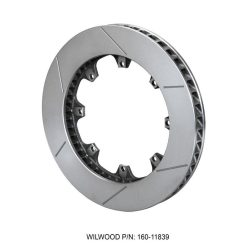
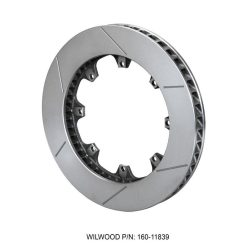
These Wilwood brake discs are primarily GT 48 Curved Vane slotted rotors engineered for high-demand motorsport and performance road applications. The Spec-37 iron alloy and 48 curved internal vanes offer outstanding thermal stability, crack resistance and long service life under repeated hard braking. Directional left- and right-hand rotors are designed to be used with matching Wilwood hats, making them ideal for short track, road course and powerful street cars that require consistent, fade-free braking.
Net price: 192 €
Net price: 192 €
Wilwood brake discs for motorsport and performance road cars
Wilwood brake discs in this category focus on GT 48 Curved Vane rotors, a popular choice in competition and serious track day use. Manufactured from Spec-37 iron alloy, these rotors are designed to withstand extreme temperatures with a high degree of resistance to distortion, cracking and rapid wear. The combination of 48 curved cooling vanes and a slotted face gives excellent heat capacity, fast cooling and consistent braking even during long, hard sessions on circuit or mountain roads.
Technical Basics
The Wilwood GT 48 series rotors feature 48 curved internal vanes that act as an efficient pump, drawing cool air in from the centre and expelling hot air at the outer edge. This curved vane design significantly improves cooling compared to straight vane discs, helping to delay fade and keep pad and disc temperatures within a safe range. The proprietary Spec-37 iron material is formulated specifically for high-stress rotor use, offering superior crack resistance and dimensional stability under repeated thermal cycling.
These rotors are typically used in a two-piece, floating configuration, with the iron ring mounted to a separate aluminium hat using special bolts and hardware. This allows the rotor ring to expand and contract with heat without transferring excessive stress into the hat or hub, reducing the likelihood of warping and vibration. The slotted friction surface constantly cleans the pad face and sheds gases and debris, maintaining a consistent coefficient of friction during aggressive braking manoeuvres.
Wilwood GT 48 brake discs are produced in a range of diameters and thicknesses, such as 12.19–12.72" diameters and 1.25" (approx. 32 mm) thickness, with various bolt circles to suit different hats and hubs. Many part numbers, like 160-11839 and 160-11840, are sold as left-hand (LH) and right-hand (RH) specific rotors, with vane direction optimised for correct rotation. Matching the exact size, thickness, vane direction and bolt pattern to the intended hat and caliper setup is essential for safe operation.
Selection Criteria
Selecting the right Wilwood brake disc starts with identifying your existing brake system: caliper model, hat type, hub dimensions and current rotor size. Each rotor part number corresponds to specific parameters such as diameter, thickness, bolt circle and vane geometry, so you must cross-check these against your current setup. Using the wrong rotor can compromise brake balance, pad contact area or even basic fitment, so accurate measurements and part-number matching are critical.
Your application type strongly influences the specification you need. For fast road and occasional track days, a GT 48 slotted rotor paired with a suitable performance pad will usually provide a major improvement over OEM discs. For intense circuit racing, endurance events or very heavy, powerful cars, you may need larger diameters, thicker rotors, more aggressive pad compounds and high-temperature fluid to maintain consistent braking over long stints.
Pad choice is one of the most important factors in getting the best from Wilwood rotors. Highly aggressive race pads deliver exceptional high-temperature performance but can be noisy, dusty and harsh on discs in everyday driving. For primarily street-driven cars, a more moderate sport pad with a broad operating range offers a better balance of comfort and performance. Always follow the recommendations of Wilwood and the pad manufacturer to match pad characteristics to your rotor and usage.
Installation & Maintenance
Proper installation of Wilwood brake discs is essential for safety and performance. The hub and hat mounting faces must be thoroughly cleaned to bare metal so that the rotor sits perfectly flat, without rust or debris trapped underneath. Rotor and wheel fasteners should be tightened to the specified torque, using thread locker where recommended, and rotor run-out should be checked with a dial indicator to stay within Wilwood’s tolerances.
Every new rotor and pad set requires a structured bedding procedure. This typically involves a series of moderate stops followed by progressively harder braking, building heat gradually and allowing the discs to cool slightly between runs. Done correctly, this creates an even transfer layer on the rotor face, which minimises judder, hotspots and the risk of thermal cracking. Skipping bedding, or overheating the system from cold, can quickly damage even high-quality performance rotors.
Ongoing maintenance includes regular measurement of disc thickness to ensure it remains above the minimum specified value, along with inspection for heat checking, deep grooves and heavy discolouration. After track days or mountain runs, you should visually inspect the rotors and pads for signs of overheating or uneven wear and address any issues promptly. Persistent vibration, steering shake or pulsing under braking are warning signs that hub cleanliness, run-out or hardware issues must be investigated before further hard use.
FAQ
How are Wilwood GT 48 rotors different from stock brake discs?
Wilwood GT 48 rotors use a Spec-37 iron alloy, 48 curved cooling vanes and a slotted face, whereas most OEM discs are plain, one-piece cast iron. This design offers greater heat capacity, better cooling and improved resistance to warping and cracking under extreme use. The result is more consistent, fade-resistant braking in demanding conditions.
Can I use Wilwood brake discs for daily driving?
Yes, many Wilwood brake discs can be used on the road when combined with an appropriate fast-road pad compound. You may experience slightly more noise and dust than with plain OEM discs, but you gain better bite and higher resistance to fade. For primarily street-driven cars, choose a pad that balances comfort with the extra performance you need.
Why do Wilwood GT 48 rotors come in left- and right-hand versions?
The 48 curved vanes in Wilwood GT 48 rotors are directional, so they must rotate in the correct direction to pump air and cool effectively. This is why there are separate left-hand (LH) and right-hand (RH) part numbers. Installing them on the wrong side reduces cooling performance and can increase the risk of overheating.
Which brake pads should I use with Wilwood GT 48 rotors?
For track and competition use, a dedicated race pad with a high operating temperature range is recommended to match the capabilities of the GT 48 rotor. For mixed road and track use, a sport pad with good cold bite and strong high-temperature performance is usually a better compromise. Always ensure pad and rotor are compatible and suited to your actual driving conditions.
Do I really need to bed in new Wilwood brake discs?
Yes, proper bedding is vital to ensure even pad material transfer and to avoid judder, hotspots and premature cracking. A controlled sequence of medium-to-hard stops brings the system up to temperature without shock-loading the rotors. This simple step greatly improves braking feel, consistency and component life.
How long do Wilwood GT 48 brake discs last?
Service life depends on vehicle weight, power, driving style and pad choice, but the Spec-37 iron alloy and curved vane cooling are designed for long life under demanding conditions. Circuit racing, heavy track use or aggressive pads will all accelerate wear, so regular inspection and thickness checks are essential. Replacing rotors before they reach minimum thickness is far cheaper than repairing damage to calipers, bearings or hubs.
