
The Subaru control arms category focuses on heavy-duty adjustable rear control arms and camber links for high-performance Japanese sports cars. These reinforced arms let you fine-tune suspension geometry on lowered, track or drift builds, improving grip, cornering stability and tyre life. They are ideal wherever the factory multi-link rear suspension no longer offers sufficient adjustment range.
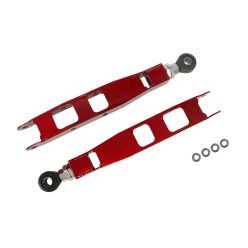
Net price: 97 €
Subaru control arms for precise handling and even tyre wear
Subaru control arms are reinforced rear and upper links that help you set up and stabilise multi-link suspensions on performance-oriented cars. The adjustable rear upper arms and camber links available in this category are particularly useful on lowered cars where the stock geometry is no longer suitable. Their extended adjustment range allows you to tailor alignment to your needs, whether that is daily driving, track days or drift. Incorrectly set or worn arms reduce grip, make the car nervous in corners and cause severe uneven tyre wear.
Technical Basics
On multi-link Subaru-style suspensions the rear control arm system determines camber, toe and the fore-aft position of the wheel. Adjustable upper arms use threaded sections or uniball spherical joints so that geometry changes can be made in small, precise steps. Quality arms use thick-wall tubing, strong welds and corrosion-resistant finishes to withstand high lateral forces. Correct alignment keeps the tyre contact patch in optimal contact with the road under acceleration, braking and cornering, improving both performance and safety.
When a car is lowered significantly, factory camber values often become too negative, which quickly destroys the inner shoulders of the tyres. Adjustable links allow you to bring camber back into a sensible range while still benefiting from a lower centre of gravity. Poorly designed or weak control arms can bend or even break under heavy loads, particularly when combined with sticky tyres and high cornering forces. For this reason critical suspension parts should always be sourced from trusted manufacturers and installed following the recommended torque specifications.
Selection Criteria
When choosing a Subaru control arm, start by confirming the exact model and chassis code, as mounting points can differ between WRX/STI, rear-wheel-drive coupés and other sporty variants. Consider how the car will be used: mostly street driving, a mix of road and track days, or primarily motorsport such as time attack or drift. For daily use it is usually best to stay close to stock alignment with only mild negative camber, while competition setups may require more aggressive angles. Wheel width, offset and tyre size also dictate how much adjustment range you will need.
If you run wide, sticky tyres, a stronger differential, big brakes or significant power upgrades, suspension loads will increase dramatically. In these cases reinforced adjustable rear arms and camber links are strongly recommended to keep geometry stable over time. For drift or serious track work, correct rear alignment is crucial for traction on corner exit and overall balance at the limit. Cheap parts from unknown brands can be a false economy; an under-engineered arm that fails at speed can cause major damage and represents a serious safety risk.
Installation & Maintenance
Replacing Subaru control arms requires clean mounting faces, quality hardware and adherence to the specified torque values. Threaded adjusters must be locked with jam nuts or factory-style devices after alignment so they cannot unwind under vibration. Final tightening should be done with the suspension close to normal ride height, so rubber bushes are not twisted at rest. A professional wheel alignment is always necessary after installation, because even the best components rely on correct geometry to deliver their full potential.
Maintenance includes periodic visual inspection of arms, ball joints and welds, especially if the car sees regular track use or rough roads. Any sign of cracking, deformation, rust thinning or noticeable play means the affected part must be replaced immediately. Keeping steel surfaces clean and protected helps preserve the strength of steel arms over many seasons. Ignoring unusual noises, a wandering rear end or rapid tyre wear can allow a minor issue to develop into a major suspension failure at high speed.
FAQ
When should I fit adjustable rear arms to a Subaru? Adjustable control arms are recommended if the car is significantly lowered, runs wide tyres or regularly attends track days. In these cases the factory camber and toe settings are often no longer ideal, and fine-tuning geometry improves grip and stability. If you notice uneven tyre wear or unstable behaviour in corners, upgrading and aligning the suspension is a wise step.
Is wheel alignment necessary after changing Subaru control arms? Yes, a full alignment is essential after any control arm replacement, especially when adjustable links are installed. New arms may change camber and toe values due to different dimensions or bushing stiffness. Driving without a proper wheel alignment will usually lead to poor handling and rapid tyre wear.
Are performance Subaru control arms suitable for daily road use? Quality reinforced control arms are suitable for everyday use as long as alignment settings remain sensible. Very aggressive negative camber and extreme toe angles that work well on track will increase rolling resistance and tyre wear on the road. For mixed use it is best to run a comfortable street alignment and only dial in more extreme values for events.
What symptoms indicate that Subaru rear control arms are worn? Typical warning signs include clunking noises over bumps, the car pulling under braking, a loose-feeling rear end and patchy tyre wear. If you feel play at the mounting points when the car is lifted, or see cracks around welds, replacement is urgent. Often it is wise to replace both arms on the same axle at the same time.
Is it worth buying very cheap, unbranded control arms? For critical components like the rear control arm very cheap, unbranded parts represent a significant risk. An under-engineered or poorly welded arm can fail under load, causing loss of control and expensive damage. In practice, reputable brands with proven designs are far more cost-effective over the long term.
