
In Stainless Steel Braided PTFE (Teflon) Fuel Hoses, you’ll find PTFE-lined fuel hose with stainless steel braid protection for custom builds. The current range is offered in AN16 and AN20, with “Stainless Steel Braid” and Double Braid variants. For the full hose assortment, go back to Fuel Hoses.
As this is a LEAF page, use filters (price/availability), sort the list, then open a product card to confirm size and braid type. Choose the right PTFE hose and check out.
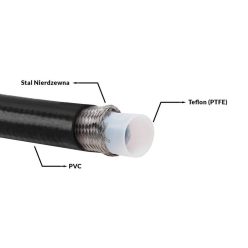
Net price: 33 €
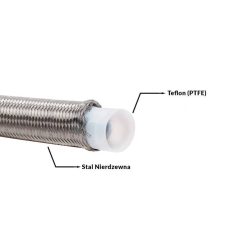
Net price: 32 €

Net price: 47 €
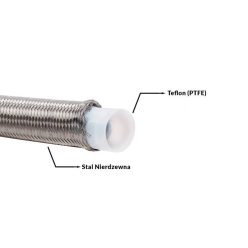
Net price: 41 €
Stainless Steel Braided PTFE (Teflon) Fuel Hoses – low permeation, strong chemical resistance, and big AN sizes
Stainless Steel Braided PTFE (Teflon) Fuel Hoses are PTFE-lined hoses protected by stainless steel braid, designed for performance fuel-system builds where chemical stability and long-term reliability matter. They’re often chosen to reduce fuel smell/permeation compared to many rubber-lined hoses and to handle demanding routing in track and tuned applications.
This category currently includes AN16 and AN20 hose options from TURBOWORKS, available as “Stainless Steel Braid” and Double Braid versions. The products are sold in 100 cm units; when you buy more than one unit, the hose is typically supplied as one continuous length (up to 5 m), which helps you avoid unnecessary joins.
Technical Basics
A PTFE hose is built around a PTFE liner that provides chemical resistance, while the outer stainless braid adds abrasion and impact protection. A Double Braid construction can improve external protection further, but it usually increases stiffness, so routing and bend clearance become more critical.
AN size (for example AN16 or AN20) is only part of fitment; the correct hose ends and the available bend radius are just as important. PTFE hoses typically require PTFE-specific hose ends using an olive/ferrule, not standard rubber-hose ends, to achieve a reliable seal.
Important: the most common issues come from incorrect hose ends or forcing tight bends. A kinked line can create hidden pressure drop and unstable fuel delivery, even if the pump and filters are sized correctly.
Selection Criteria
Start with the job of the line: main feed, return, tank-to-surge-tank link, or an engine-bay section. Large sizes like AN20 make sense only when your system flow demand and connection points support it; otherwise, you’ll add packaging difficulty and fitting cost without a real benefit.
Next, pick the braid level: standard stainless braid is often easier to route, while double braid can be a better match for harsh environments where abrasion risk is high. Choose based on the real installation environment—heat sources, underbody exposure, bulkhead pass-throughs—not on “bigger is always better”.
Finally, plan the full system: filters, regulator, fittings and mounting work together. Related terms you may see include PTFE fuel line, Teflon hose, braided PTFE hose, AN hose, hose end, olive (ferrule).
Installation & Maintenance
Plan routing before cutting: PTFE hose is typically stiffer, so bend radius and hose-end clearance matter. Keep lines away from sharp edges and exhaust heat, and use proper mounting so vibration doesn’t load the fittings.
Ordering tip: these hoses are sold per 100 cm unit, and multi-unit orders are usually supplied as one piece up to 5 m, which helps you build a cleaner, uninterrupted route. After assembly, do a leak/pressure test and re-check joints after a heat cycle.
Safety: fuel work is a fire risk; depressurise, ventilate, and only run the system once everything is completely leak-free. Replace any hose showing braid damage, kinks or seepage near a hose end.
FAQ
Are PTFE (Teflon) fuel hoses suitable for E85?
PTFE is often selected for ethanol blends because of its chemical resistance. However, the final result depends on compatible hose ends, O-rings and the rest of the system materials. Always pressure-test and inspect fittings after installation.
Stainless braid vs double braid: what’s the difference?
Standard stainless steel braid provides external protection, while double braid adds another reinforcement layer. Double braid can be tougher but may be stiffer and harder to route in tight spaces. Choose based on abrasion risk and available clearance.
Do I need special fittings for PTFE hose?
Yes—PTFE typically needs PTFE-specific hose ends that seal with an olive/ferrule. Rubber-hose ends may not seal reliably on a PTFE liner. Confirm the hose-end description states PTFE compatibility.
What does “100 cm unit, supplied in one length” mean?
You order in 100 cm increments. When ordering multiple units, the hose is commonly supplied as one continuous piece up to 5 m, reducing the need for joins. Measure your route first so you order the right total length.
Why is bend radius so important on PTFE lines?
PTFE hose can kink if forced into tight bends, which can restrict flow and cause pressure drop. Proper routing and mounting reduce stress on hose ends and help prevent leaks. In engine bays, add heat protection and clearance where needed.
Filter by size and braid type, confirm PTFE-compatible hose ends, and order the hose that matches your build.
