
Pedal Boxes and Accessories bring race-car level control to your brake, clutch and throttle systems with rigid pedal box assemblies and matching hardware. Floor-mounted and overhung pedal sets with adjustable balance bars, dual or triple master cylinder layouts and throttle linkage kits are ideal for track, drift and rally builds. The range includes solutions from Wilwood, Tilton, Rally Design, FTWL and Turboworks, plus cables, brackets, floor plates and remote adjusters to fine-tune ergonomics and brake bias.
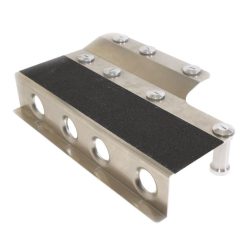
Net price: 98 €
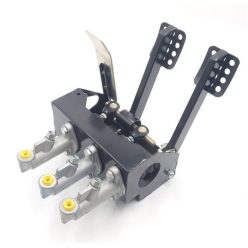
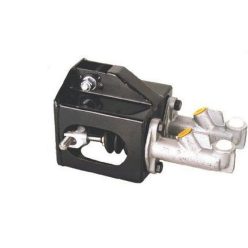


Net price: 196 €
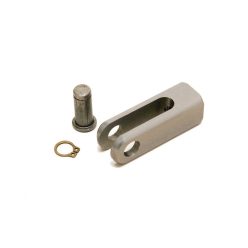
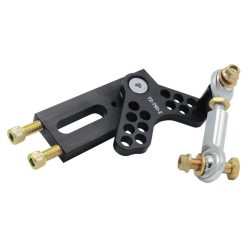
Net price: 164 €

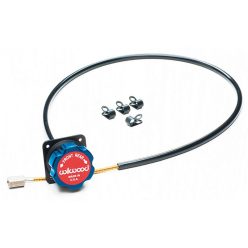
Net price: 70 €
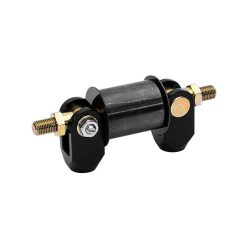
Role and Key Benefits of Pedal Boxes
Pedal boxes and accessories form the control centre of your hydraulic brake and clutch system, as well as the throttle. A well-chosen pedal box not only gives you an ergonomic pedal layout, but also adjustable brake bias, a firmer and more consistent pedal feel and better modulation under load. Floor-mounted and overhung assemblies usually feature separate brake, clutch and throttle pedals, along with an adjustable balance bar linking two brake master cylinders. This allows you to fine-tune front/rear brake bias for track days, endurance racing or drift, while keeping the driver’s footwork natural and repeatable.
Technical Basics
Most performance pedal boxes share a number of design features: a rigid welded or CNC-machined frame, high-strength steel or aluminium pedal arms and an adjustable balance bar assembly. The brake pedal typically drives two separate master cylinders—one for the front circuit, one for the rear—connected via the balance bar. Moving the spherical bearing along the bar changes the mechanical leverage between the circuits, altering brake bias. Common pedal ratios are in the 5:1 to 6.25:1 range, balancing pedal effort against stroke to give good feel with typical caliper sizes and master cylinder bores.
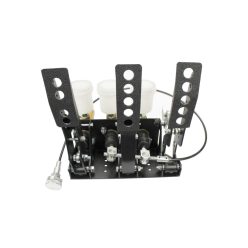
Pedal systems can be floor-mounted or overhung / firewall-mounted (swing or reverse swing). In a floor-mount design, the pedals pivot from the floor and master cylinders are located ahead of or behind the assembly, which suits tube-frame and heavily modified cars where the footwell can be reworked. Overhung designs mount the pedal assembly to the bulkhead or a cross-beam above the driver’s feet, with master cylinders on the engine bay side of the firewall, more similar to many OE layouts. Wilwood, Tilton and similar brands offer dual-pedal (brake/clutch) and triple-pedal (brake/clutch/throttle) configurations with different mounting geometries and cylinder patterns.
Associated accessories include throttle bell-cranks and cable linkages, remote brake bias adjusters, replacement pedal pads, floor plates and reinforcement brackets. These let you tailor pedal spacing, height and angle to suit the driver’s seating position, shoe size and driving technique. A well-set-up pedal box supports confident left-foot braking, smooth heel-and-toe downshifts and stable car control in long corners or transitions, particularly in drift and rally environments where precise pedal modulation is vital.
Selection Criteria
When choosing a pedal box, the first decision is mounting style: floor-mount or overhung. Floor-mounted systems are popular in space-frame race cars, kit-cars and heavily stripped track builds where the original pedal area no longer exists or is heavily modified. Overhung or firewall-mounted units integrate well with more standard bulkheads and can simplify plumbing when the master cylinders remain in the engine bay. Check the advertised pedal ratio (for example 5:1 or 6.25:1), centre-to-centre pedal spacing and whether the throttle is designed for cable or rod linkage.
Next, decide whether you need a two-pedal (brake/clutch) or three-pedal (brake/clutch/throttle) assembly. If you retain the OEM throttle pedal and only want independent front/rear brake circuits with a clutch, a dual-pedal box might be sufficient. For fully custom interiors, a triple pedal assembly often makes more sense, especially when you want matching pedal pads and adjustable throttle position. For serious track and drift builds, an adjustable balance bar with provision for a remote cockpit adjuster is highly desirable, allowing on-the-fly bias tuning as fuel load and grip levels change. For mixed road/track use a simpler, less frequently adjusted setup may be enough, especially if the car still runs ABS.
Compatibility with your chosen master cylinders is another critical factor. Most Wilwood, Tilton, OBP and similar units use standard bolt patterns and pushrod interfaces, but always verify mounting centres, bore sizes (0.625", 0.7", 0.75" etc.) and port threads. Bore selection directly affects pedal feel and line pressure, so the pedal box should be considered together with caliper piston area, pedal ratio and intended usage. If your build also uses a hydraulic handbrake, remember to plan the system so that all circuits—foot brake, handbrake and clutch—work harmoniously without unexpected interactions or over-complicated plumbing.
Installation & Maintenance
Installing a pedal box is a structural and safety-critical job, so professional installation or an experienced race builder is strongly recommended. The pedal box frame must be mounted to strong chassis points—reinforced floor, bulkhead or crossmembers—so it cannot flex or move under hard braking. Pedal stops and end-stops must be correctly set so that the master cylinders are not over-stroked and the pedals do not hit the floor, steering column or dash at full travel. Throttle cables and clutch/brake pushrods should be adjusted to minimise free play while still providing a small safety margin to prevent pre-loading.
Ongoing maintenance includes regular inspection of pedal pivots, bushings, clevis pins and the balance bar. Any binding, squeaking or unusual play at the pedal pivot points needs attention—often a sign of wear or insufficient lubrication. Remote brake bias adjusters should be checked to ensure the cable moves freely and the knob does not creep under vibration. Non-slip pedal pads should be kept clean and free from oil, rubber dust or debris to maintain grip, especially when driving in wet conditions or with race boots.
Whenever you change settings—such as brake bias, pedal stops or pedal height—record the positions so you can revert to a known-good setup later. For competition cars, it is wise to schedule a full pedal box inspection at the start of each season: strip, clean and re-grease the pivots, check welds and fasteners and replace any worn parts. A failure in the pedal assembly on track is both dangerous and potentially very costly, so preventative maintenance is a key part of a reliable braking package.
FAQ
What advantages does a pedal box have over an OEM pedal assembly?
A quality pedal box offers adjustable brake bias via a balance bar, optimised pedal ratios and improved ergonomics compared with most factory setups. This results in better modulation, more consistent pedal feel and greater confidence under heavy braking, which is crucial for competitive track, rally and drift driving.
Should I choose a floor-mounted or overhung pedal box?
For stripped or tube-frame cars, a floor-mounted pedal box is often easier to package and brace. For builds that retain a largely original bulkhead and engine bay layout, an overhung or firewall-mounted assembly can integrate better with existing master cylinders and brake lines. The right choice depends on chassis layout and fabrication possibilities.
How do master cylinder bores affect pedal feel?
Smaller bore sizes generate higher hydraulic pressure with more pedal travel and lighter effort, while larger bores shorten travel but increase required force. Matching bore size to caliper piston area, pedal ratio and usage (street, track, race) is essential for a usable, confidence-inspiring pedal.
Can I use a pedal box with an ABS-equipped car?
Yes, but integrating a pedal box into an ABS system requires careful planning. Circuit layout, master cylinder sizing and brake bias must be designed so the ABS module receives appropriate pressures and flow, otherwise it may intervene prematurely or struggle to modulate correctly under extreme conditions.
What maintenance does a pedal box require?
Regularly inspect pivot pins, bushings, balance bar operation and all mounting fasteners. Lubricate moving parts as recommended by the manufacturer and check for cracks, deformation or looseness after hard events. Any spongy feel, unusual noises or increasing play in the pedals should prompt immediate inspection and, if needed, replacement of worn components.
