
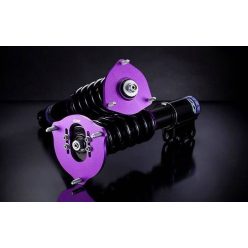
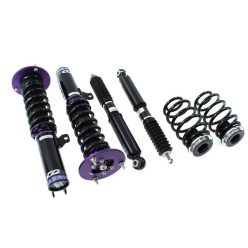
Saab – D2 Racing Street suspension kits are road-focused, height-adjustable spring–damper packages for 900/9000, 9-3, 9-5 and more. Threaded bodies with refined damping sharpen cornering and steering feel while preserving daily comfort. Before purchase, confirm axle loads, drivetrain (FWD/AWD) and stay within the approved adjustment range.
Net price: 1 079 €
Net price: 1 079 €
Net price: 1 079 €
Net price: 1 079 €

Net price: 1 079 €
Brief summary & key benefits
Saab – D2 Racing Street kits deliver steadier body control, precise ride-height tuning and predictable handling while preserving daily comfort. A measured drop lowers the centre of gravity, trims pitch/roll and clarifies steering across classic 900/9000 and modern 9-3/9-5 platforms.
Technical Basics
Each package pairs gas-charged dampers with vehicle-specific steel springs. A threaded body with locking collars allows secure per-axle height changes; dust boots and quality seals protect sliding parts, and exterior components receive anti-corrosion finishes. Depending on application, springs may be linear for direct feedback or dual-rate/progressive to improve small-bump compliance while maintaining support under load. Heat-stable oil keeps damping consistent during temperature swings and long journeys.
Platform notes: most Saabs are FWD, with some AWD (XWD) variants. Excessive lowering can reduce usable bump travel, alter control-arm angles and degrade compliance, especially on rough roads. Heavier turbo powertrains and bigger brake/wheel packages add unsprung mass, so street setups favour conservative heights and measured rebound to preserve travel and braking attitude.
Selection Criteria
Use case — For commuting and long motorway work, begin near a mid-range height to retain travel, comfort and alignment latitude. Lower slightly for occasional events only if wheel-arch clearances and bump stops remain safe; document each change to build a reliable baseline.
Body/drivetrain — On FWD models prioritise front camber/toe targets for a neutral balance. AWD (XWD) variants carry extra hardware mass that shifts axle loads; start with conservative rear support and refine rebound to keep the chassis settled over long undulations.
Tyres & wheels — Larger wheels and shorter sidewalls cut compliance and raise bottom-out risk. On street tyres, moderate camber and middle ride heights protect tyre life and keep steering linear; stickier compounds may justify a touch firmer rebound. Re-check arch clearances at full lock and under compression after any height change.
Brakes & unsprung mass — Big-brake/wide-wheel sets increase unsprung mass and thermal load; respond with careful damping tweaks and avoid extreme camber that accelerates inner shoulder wear and harms comfort.
Everyday usability — Ultra-low stances increase NVH and reduce travel. For mixed daily roads, conservative heights with balanced toe and sensible camber keep the chassis composed over crests and compressions and protect underbody components.
Installation & Maintenance
Have a qualified shop install the kit. Clean threads and apply light anti-seize; torque fasteners to factory specs and preload rubber bushes at ride height. After a shakedown drive, re-torque and perform a four-wheel alignment (camber/toe/caster). Verify wheel-arch and bump-stop clearances at full lock and under compression, especially when running wider wheels or lower heights.
For longevity, periodically wash threaded sections, refresh anti-corrosion spray and ensure lock collars remain tight. Any knocking, oil mist or pogo-like behaviour warrants inspection of dampers, top mounts and mounting points. Keep a written baseline (height/damping/camber) so you can revert quickly between daily and event settings or seasonal tyres.
FAQ
Q: How low can I go for street use?
A: Stay within the manufacturer’s approved range and start near mid-height to preserve travel and geometry.
Q: Are XWD (AWD) cars set up differently?
A: Yes — different axle loads and hardware mass call for conservative heights and measured rebound.
Q: Do big wheels reduce comfort?
A: Short sidewalls cut compliance; consider a slightly higher ride height and measured damping for daily roads.
Q: Is alignment mandatory after installation?
A: Yes — lowering alters geometry; perform a full alignment after fitting and after any height change.
Q: What baseline should I begin with?
A: Mid-height, modest front camber and the recommended rebound baseline; adjust in small, documented steps.
