
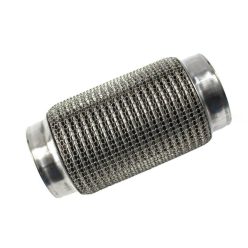
A reinforced 304SS exhaust flex pipe is the flexible section in an exhaust system that helps manage vibration, heat expansion and load changes caused by engine movement. It is the right choice when inside diameter, body length and the available installation space genuinely match your system.
Verify exact dimensions and specifications on the product card; in-stock items dispatch fast within the EU.
Start by checking the inside diameter and body length, then confirm how much room remains for weld zones and nearby components. Rather than installing the section under tension, leave the exhaust a natural range of movement so the flex and adjoining sections are less likely to be overstressed.

Net price: 38 €
Net price: 63 €
Net price: 88 €

Net price: 101 €

Net price: 107 €
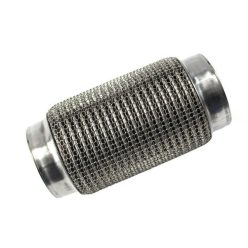
Net price: 64 €
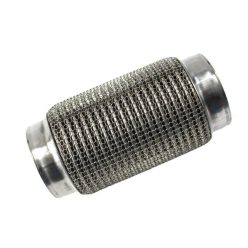
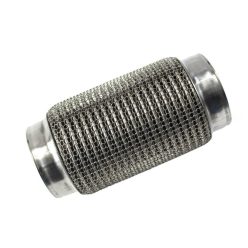
Net price: 18 €

Net price: 12 €

Net price: 16 €
Reinforced 304SS Exhaust Flex Pipes – managing thermal movement and vibration in exhaust builds
This weld-in flexible exhaust section—often searched by builders as a reinforced 304 stainless flex joint—is used so the system does not pass every movement into rigid tube sections and welds. It works best when sizing, installation position and support strategy are considered together.
Technical background and system integration
Flexible section: the role of an exhaust flex pipe is to absorb part of the load created by engine rock, resonance and thermal growth, so rigid sections and nearby joints may see less side loading.
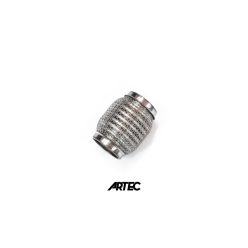
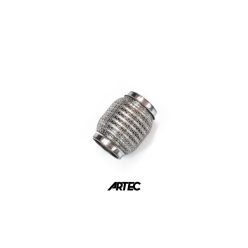
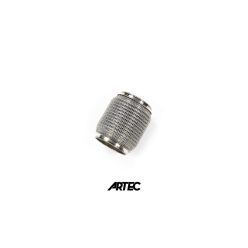
Reinforced design: a 304SS-based flex section with external reinforcement suits projects where the system needs controlled movement rather than a purely rigid connection path.
- Inside diameter: the range on this page runs from 45 mm up to 101 mm, so selection should start from the real tube size already on the car or build bench.
- Body length: typical lengths here include 100, 150, 200 and 250 mm, which changes how much movement the flex section can handle.
- Size format: Turboworks items are mainly listed in mm, while ARTEC options appear in 1.5in to 4in sizes, so always confirm the product-card dimensions directly.
How to choose the right one
Quick selection: begin with tube diameter, then measure the body length you can realistically package, and only then judge how close the flex section will sit to the manifold, catalyst or the next rigid section.
Sizing logic: a shorter body can suit tighter packaging, while a longer body may allow more movement absorption, provided the rest of the exhaust is also supported sensibly. This page includes both ARTEC and Turboworks options, so filters plus the product card usually give the safest answer.
In this category, the most reliable approach is to measure your existing pipework first and then compare those numbers with the listed diameter and body length instead of choosing by name alone.
- Clearance: leave room not only for the flex body itself but also for weld zones and nearby movement.
- Position: it is often more practical when the flex section is not placed directly beside the most rigid or hottest point in the system.
- System length: on a longer exhaust route, support-point layout has a major effect on how the flex section behaves.
- Service access: think ahead about how easy it will be to reach the flex and surrounding joints if the system later needs inspection.
Installation and failure-prevention tips
Alignment line: before welding, trial-fit the section and check that the flex pipe sits on the natural axis of the exhaust. If it has to be pulled sideways into place, the flexible section can be loaded much harder than intended.
Common issue: when a flex pipe is installed in twist, preload or too close to rigid connection points, later rattling, blow-by or fatigue around the braid and end sections may point to trouble; this is often caused by poor placement, incomplete hanger support or a body length that is too short for the route. Prevent it with a dry mock-up, by checking support alignment, and by letting the system sit naturally while cold.
Re-check: after the first heat cycle, inspect the welds, rubber hangers and the remaining clearance to the floor, heat shields and other rigid parts.
PRO TIP: On a multi-section exhaust, do not position the flex in isolation; judge it together with the manifold side, centre section and rear support points so the whole route is less likely to preload itself.
FAQ
Which specification should I check first?
Start with pipe diameter because that decides whether the part can physically match the system. After that, confirm body length and the real installation space around the weld zones.
What is the difference between a shorter and a longer body?
A shorter unit can be easier to package in a tight area. A longer body may handle more movement, but only when the surrounding pipework and hangers are laid out sensibly.
What is the most common failure or installation mistake?
With the system cold, check that the flex is not twisted, the two end sections sit in line, and the rubber hangers are not dragging the exhaust sideways. Then inspect nearby clearances and repeat the check after the first full heat cycle.
Should I choose by ARTEC or Turboworks sizing?
Your own exhaust dimensions should always come first. One brand may present the size in inches and the other in millimetres, so the product-card measurements matter more than the name format.
How do I know the flex section is in the right place?
You are usually on the right track when the exhaust sits naturally while cold, the joints are not being pulled sideways, and the system still keeps sensible clearance to the floor and heat shields when hot. It is worth checking the position again after initial use.
