
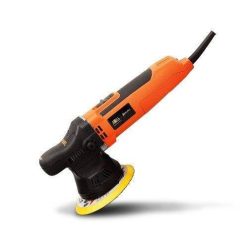
Our Polishing Machines help you correct paint safely and efficiently. Consider drive type (rotary or dual action/DA), throw length, backing plate size and speed range. Pairing the right machine with suitable pads reduces holograms, manages heat on delicate clear coats and speeds up cutting, polishing and finishing stages.
Brief summary & key benefits
Polishing Machines remove defects and refine clear coats in a controlled way. Modern dual action tools minimise holograms and are safer for beginners, while rotary units deliver stronger cut for rapid correction. With the right pad–polish–speed combo you can shorten process time and achieve a more consistent gloss.
Technical Basics
Two main drives exist: rotary (pure rotation) and dual action (rotation + oscillation). Typical DA throw ranges from 8 to 21 mm; larger throws increase correction rate, smaller throws improve control. Backing plates commonly use M8/M14 threads with 75 mm or 125 mm sizes. Speed is specified as OPM for DA or RPM for rotary; load-controlled electronics keep torque stable under pressure.
Pads set the character of the system: open-cell foam runs cool and cuts well, microfibre pads boost cutting, wool offers the fastest removal, while dense soft foam is ideal for finishing. Compounds are grouped as cut, polish and finish. Different clear coats respond differently, so always test a section first.
Heat management is critical: clear coats are thin, so excessive pressure and edge contact are risky. Keep the machine flat, clean pads frequently, and blow out dust to prevent marring. Fresh pads and proper priming improve consistency.
Selection Criteria
Use case: for enthusiasts and delicate finishes, a DA provides forgiveness; for severe oxidation or production speed, a rotary is faster. Many workflows start with DA + microfibre for cutting and finish with a smaller-throw DA and soft foam.
Ergonomics & weight: look for low vibration, balanced weight and comfortable grips. Long cables (4–5 m) and slim bodies reduce fatigue.
Electronics: useful features include soft start, constant speed control and thermal protection. A spindle lock speeds plate changes; a stepless dial gives precise adjustment.
Pad & plate size: on large panels a 125 mm plate with 135–150 mm pads is efficient; on tight areas a 75 mm plate with 80–100 mm pads improves control. Oversized pads can stall the machine; undersized pads may feel twitchy.
Compounds: hard German clears often need stronger cut; softer Japanese clears may finish best with medium/fine sets. Build your process from a test spot.
Installation & Maintenance
Prep: thorough wash, tar removal, iron fallout remover, then clay for bonded contamination. Work in shade on cool panels. Centre the pad carefully, start at speed 1–2 and ramp up smoothly.
Process: work 40×40 cm sections with 50% overlap. Prime new pads lightly (priming), then apply 3–4 pea-sized drops per cycle. Keep the pad flat and protect edges with masking tape. Avoid loading on textured plastics or rubber trims.
Aftercare: wipe residue with a clean microfibre, inspect after an IPA wipe-down. If needed, refine with a softer combo and protect with wax, synthetic sealant or ceramic coating. Wash and dry pads after use to preserve their structure.
Safety: wear hearing protection and safety glasses. Manage the cable, monitor panel temperature and take cooling breaks to avoid haze or smearing.
FAQ
Q: Should my first machine be DA or rotary?
A: A DA is safer and more versatile to start with. Rotary offers faster correction but demands more skill.
Q: What throw size works best?
A: 8–12 mm for precise finishing; 15–21 mm for faster correction. Larger throw speeds work but can be trickier on curves.
Q: How do I avoid holograms?
A: Switch to a softer pad and finishing polish, reduce speed, and keep the pad flat. DA machines naturally finish hologram-free more easily.
Q: How much compound should I use?
A: Light priming on a new pad, then 3–4 pea-sized drops per cycle. Excess product dusts and smears.
Q: When should I replace pads?
A: When the foam collapses, cutting drops, or the pad overheats. Clean frequently and rotate pads during long sessions.
