
Peugeot – MTS Technik Suspension Kits deliver vehicle-specific, height-adjustable spring–damper solutions for daily and spirited driving. Threaded bodies enable precise ride-height tuning, while matched damping improves steering feel and cornering stability. When selecting, confirm axle loads, body style (208/308/508, 2008/3008) and the approved adjustment range (GTi/PSE differences).
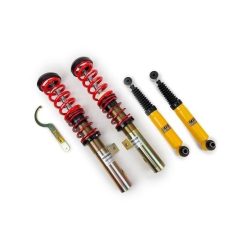
Net price: 422 €
Brief summary & key benefits
Peugeot – MTS Technik kits add calmer body control and precisely adjustable ride height to French platforms without sacrificing daily comfort. A sensible drop lowers the centre of gravity, trims pitch/roll and makes behaviour near the limit more predictable. Application-specific tuning, robust anti-corrosion finishes and quality bushings support long-term durability across varied roads and seasons.
Technical Basics
Kits pair tailored steel springs with gas-charged dampers. A threaded body and locking collars enable per-axle height changes within the approved range. Depending on application, springs may be linear for direct feedback or dual-rate/progressive for better small-bump compliance while preserving support under load. Heat-stable oil and careful valving keep damping consistent; dust boots protect sliding parts and exterior components use corrosion-resistant coatings.
Platform notes: many Peugeot hatchbacks (106/206/207/208, 306/307/308) feature a torsion-beam rear axle, while larger saloons/SUVs use different architectures. That affects rear travel, roll stiffness balance and the useful alignment window. Performance trims (GTi/PSE) often carry larger brakes/wheels and firmer bushings, shifting axle loads and the ideal spring/damping envelope. Excessive lowering reduces bump travel and may push alignment out of range—start near mid-height and fine-tune in small steps.
Selection Criteria
Use case — For commuting and fast-road driving choose a mid-range height to preserve travel and alignment latitude. For autocross/occasional track days, a slightly lower stance is acceptable if clearance and travel remain adequate.
Body/engine — 208/308/508 and 2008/3008 differ in mass distribution and stiffness; earlier 106/206/306 generations differ again. Always select the kit validated for your exact body/engine combination; PHEV battery packs can increase rear axle loads.
Performance trims — GTi/PSE models with larger brake/wheel packages and revised bushings may benefit from alternative spring rates and damping settings suited to their mass and tyre choices.
Tyres & wheels — Larger wheels and shorter sidewalls increase bottoming risk; adapt ride height and check bump stops. Street tyres generally suit recommended rates; semi-slicks may call for stiffer springs and matching damping.
Alignment — After lowering, perform a full four-wheel alignment (camber/toe/caster). Torsion-beam rears may limit camber adjustment; front camber tuning helps balance grip and straight-line stability.
Installation & Maintenance
Have a qualified shop fit the kit. Replace worn top mounts, check dust boots and bump stops. Clean threads and apply a light anti-seize before assembly so later adjustments remain easy. Torque all fasteners to spec and preload rubber bushes at ride height. After a shakedown drive, re-torque and align.
For longevity, periodically wash threads, refresh anti-corrosion spray and verify that lock collars have not moved. Keep a written baseline (height/damping) to revert between road and event settings. Any knocking, oil traces or pogo-like behaviour warrants immediate inspection of dampers and mounting points.
FAQ
Q: How low can I go safely?
A: Stay within the manufacturer’s approved range to preserve travel and geometry.
Q: Is alignment mandatory after installation?
A: Yes — lowering alters geometry; set camber/toe/caster correctly after fitting and after major height changes.
Q: Do GTi/PSE trims require different kits?
A: Often yes — different axle loads and bushings call for application-matched rates and damping.
Q: What baseline should I start with?
A: Begin near mid-range height and the recommended damping baseline; fine-tune in small steps based on tyres and roads.
Q: Are cold-weather noises normal?
A: Slight NVH increases are common with firmer bushings; persistent knocking needs inspection.
