
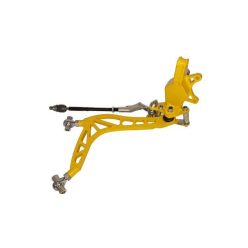
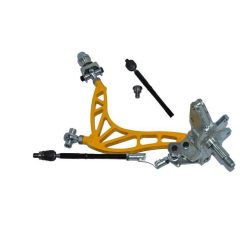
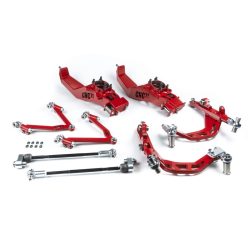
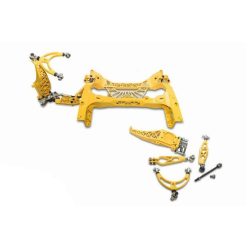
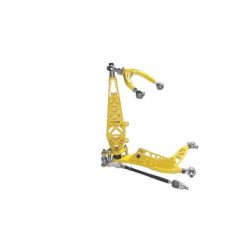
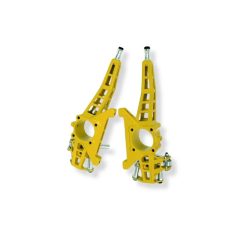
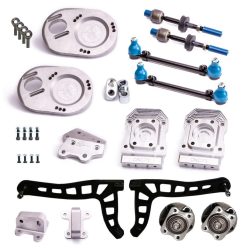
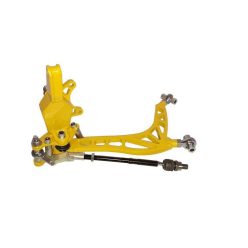
The Nissan Steering Angle Kits (Angle Kit) category covers FAT and CNC71 angle kits for S13, S14, S15, R32, R33, R34, 350Z, 370Z and 300ZX chassis. These complete steering upgrade packages – including front and rear angle kits – replace key factory components to provide drift- and track-focused geometry for serious builds and lowered street cars. A well-chosen Nissan angle kit delivers much more steering lock, more predictable transitions and sharper steering feedback.

Net price: 1 902 €

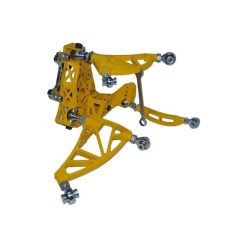
Net price: 2 189 €

Net price: 2 378 €
Nissan steering angle kits for Japanese drift and track icons
Nissan Steering Angle Kits (Angle Kit) are aimed at owners of classic rear-wheel-drive platforms such as S13, S14, S15, R32, R33, R34, 300ZX Z31, 350Z and 370Z. These cars are favourites for drifting, time attack and intensive track-day use, where stock steering lock and geometry quickly become a limitation. FAT and CNC71 angle kits use redesigned knuckles, altered steering arms, reinforced joints and, in some cases, rear angle solutions so that the entire chassis is optimised for performance driving. A properly tuned setup gives high steering angles, predictable behaviour and confident response.
Technical Basics
Factory steering geometry on most Nissans is tuned for the road, with a mild understeer balance and limited lock for safety and comfort. For serious drift and circuit work you generally need more steering lock, a different Ackermann curve and changes to caster and camber so the contact patch remains effective at large angles. An angle kit alters steering pick-up positions, pivot locations and knuckle shapes, changing how the wheel moves through bump and steer. Some kits also address the rear suspension (rear angle kits) so the car’s behaviour is balanced front to rear.
Because of the loads involved, quality kits are built from high-tensile steel or aluminium using thick-wall tubes, bracing plates and carefully executed welds. Spherical uniball joints and reinforced ball joints reduce play and elastic movement, keeping geometry consistent under load. Increasing steering angle may also affect track width and roll centre height, so spring rates, damper settings, anti-roll bars and bushings should be selected with the new kinematics in mind. Under-engineered or poorly designed kits can bend or crack when combined with sticky tyres and aggressive driving, so hardware quality is critical.
Selection Criteria
To choose the right Nissan angle kit, first confirm the exact model – S13, S14, S15, R32, R33, R34, 300ZX, 350Z or 370Z – and suspension layout. Decide whether the car will be used mainly for street driving, mixed road and track, or dedicated drifting and competition. Street and track-day builds often benefit from moderate-lock kits that retain good manners while offering much more angle than stock, whereas competition drift cars usually need maximum lock and wide adjustment ranges. Consider how the kit will work with your coilovers, anti-roll bars and rear suspension settings.
Wheel and tyre specification is equally important. Wide rims, aggressive offsets and spacers can reduce clearance and greatly increase loads on steering components. On lowered cars you must ensure that, at full lock and typical compression, the tyre does not hit the arch, chassis rails or other suspension components. In some cases, arch rolling, bump-stop tuning and precise alignment are required in addition to the kit itself. Choosing solely on price can be misleading; a cheap kit that bends or fails may end up far more expensive once tyres, damaged parts and repairs are taken into account.
Installation & Maintenance
Installing Nissan steering angle kits is a safety-critical job that usually involves removing and replacing knuckles, control arms, tie rods and joints. All fasteners must be tightened to the specified torque values using a calibrated torque wrench, and high-grade hardware should be used throughout. During installation, repeatedly check full steering lock at near-normal ride height to ensure there is no interference between tyres, bodywork or suspension parts. After any kit installation, a full four-wheel alignment is mandatory, as camber, caster and toe will all have moved away from stock settings.
Long-term reliability depends on regular inspection of welds, tubes, plates and joints for cracking, deformation or excessive play. Following drift days, track sessions or heavy kerb strikes, both front and – where relevant – rear suspension should be checked carefully, including lock nuts and adjusters. Cleaning and protecting exposed steel helps maintain the strength of steel components over time. Any unusual noises, wandering behaviour or uneven tyre wear should be treated as a warning sign that the car needs inspection and re-alignment before further hard driving.
FAQ
What advantages does a Nissan angle kit provide for drifting? A quality angle kit greatly increases steering lock, making it easier to hold big drift angles and reducing the risk of spinning at maximum steering. The revised geometry creates a smoother, more predictable transition between grip and slip, improving control with both steering and throttle. This is particularly valuable on S-chassis and Skyline-based drift cars.
Can Nissan steering angle kits be used on street cars? Yes, well-designed steering angle kits can be used on road cars provided the alignment settings are not too aggressive. Mild setups improve steering response and manoeuvrability while keeping tyre wear reasonable. Extreme drift-style geometry is best reserved for events, with more conservative values used for daily driving.
Is a wheel alignment necessary after fitting an angle kit? Absolutely. A professional wheel alignment is essential after any angle kit installation, because camber, caster and toe will all have changed. Skipping this step will make the car unstable and rapidly wear out tyres, especially at higher speeds or in wet conditions. Alignment is a fundamental part of any steering upgrade.
Are uniball-based Nissan kits comfortable for daily use? Kits using uniball spherical joints offer very precise steering and minimal play, which is ideal for track and drift, but they also transmit more noise and vibration into the cabin. Some drivers find this too harsh for everyday use. For mixed driving, you may prefer a more street-oriented setup or combine spherical joints with compliant bushings in less critical locations.
Is it safe to buy very cheap, unbranded Nissan angle kits? For critical steering components, very cheap unbranded angle kits present a serious safety risk. An under-engineered or poorly welded part can bend or fail under load, leading to loss of control and extensive damage. In practice, investing in proven kits from reputable manufacturers, installed and aligned correctly, is much safer and more cost-effective over the long term.
