
Our Nissan control arms category offers adjustable rear and front control arms, camber and toe links for 200SX, Silvia, Skyline, 350Z (Z33) and Infiniti G35 platforms. Performance parts from TURBOWORKS and PMC allow precise suspension geometry tuning for drift, time attack or fast road use. With the right setup you can improve cornering stability, steering feel and reduce uneven tyre wear on both street and track Nissans.

Net price: 148 €

Net price: 383 €
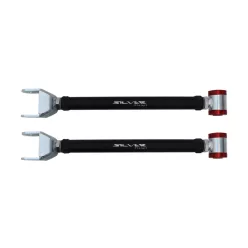
Net price: 148 €

Net price: 148 €

Net price: 148 €

Net price: 148 €

Net price: 148 €

Net price: 148 €

Net price: 148 €

Net price: 148 €

Net price: 148 €

Net price: 148 €
Nissan control arms for drift, circuit and street builds
Nissan control arms are core suspension tuning tools that define wheel camber, caster and toe on multi-link rear and front set-ups. This category covers adjustable rear upper and lower arms, camber and toe links for 200SX (S13, S14), 350Z (Z33), Skyline and related Infiniti G35 models. These components are essential on lowered, drift or circuit-prepared Nissans where factory geometry is no longer sufficient. Using worn or incorrectly specified control arms can quickly lead to unpredictable handling, excessive tyre wear and even component failure under load.
Technical Basics
On Nissan multi-link suspensions each individual control arm has a specific job: some set camber, others control toe or locate the wheel fore and aft. Adjustable arms use threaded sections, uniball joints and reinforced tube constructions to withstand the high lateral forces generated during drifting or track driving. Components from TURBOWORKS and PMC are designed to provide a wider adjustment range than OEM links, allowing geometry to be fine-tuned in small increments. A correctly set-up chassis delivers more precise steering, better traction out of corners and more consistent grip.
For drift, rear camber and toe settings are critical, as they determine how the tyre transitions between grip and slip. On circuit cars, careful adjustment of the rear suspension improves stability under braking and traction on corner exit. An under-specified arm or poor-quality weld can bend or break when hitting kerbs or suffering heavy impacts, especially with sticky tyres. For this reason, key suspension parts should be sourced from trusted manufacturers, not from unknown bargain suppliers.
Selection Criteria
When selecting Nissan control arms, first confirm the exact chassis code (such as S13, S14, S15, Z33), because attachment points and lengths differ significantly between generations. Decide whether the car will see mainly street use, a mix of road and track, or dedicated drift/time attack competition. For road-only cars, mild changes close to stock geometry can improve response without sacrificing comfort. For drift or serious track work you will typically run more negative camber, adjusted toe and a stiffer overall set-up, which demands strong adjustable links with adequate range.
If you run high-angle steering kits, wide wheels or semi-slick tyres, suspension loads rise substantially, making reinforced, adjustable arms almost mandatory. On track it is important that settings remain stable over many laps, so lock nuts must not loosen and threaded adjusters must not twist. Arms with etched or marked scales make it easier to record and repeat alignment changes when experimenting. In the long run, a reliable, properly designed suspension is cheaper than constantly replacing tyres and damaged parts caused by poor geometry or weak components.
Installation & Maintenance
Installing Nissan control arms requires clean mounting surfaces, the correct hardware and careful tightening of lock nuts after the final alignment is set. All fasteners should be torqued to the specified values, and adjusters must be locked securely to prevent them moving under load. After any arm replacement or geometry change, a professional wheel alignment is essential, especially on drift or track cars where behaviour is highly sensitive to small camber and toe changes. Incorrect installation can cause arms to loosen, wear quickly or even fail during hard driving.
Ongoing maintenance involves frequent inspection of ball joints, bushes and welds, particularly after track days or drift events with heavy kerb use. Any sign of cracks, deformation or excessive play means the affected arms should be replaced immediately. Steel components benefit from cleaning and corrosion protection to ensure that steel arms retain their strength over time. Ignoring clunks, rattles or wandering behaviour can turn a minor issue into a serious suspension failure and should never be taken lightly.
FAQ
Which Nissan models are these control arms suitable for? The range primarily targets 200SX (S13, S14), Silvia, 350Z (Z33) and related Skyline/Infiniti platforms that use multi-link rear suspensions. Each product clearly lists compatible models and years, so always check fitment details before ordering. If in doubt, confirming by VIN or exact chassis code is recommended.
Is a wheel alignment required after fitting Nissan control arms? Yes, a full wheel alignment is strongly recommended after any control arm replacement, especially when installing adjustable links. Even small differences in length or bushing deflection can alter camber and toe. Skipping alignment will usually result in rapid tyre wear and may make the car unstable, particularly at high speed or in wet conditions.
What alignment settings work well for a drift Nissan? Drift setups typically use rear camber that is slightly negative, combined with toe-in or toe-out depending on the desired balance. Exact values depend on track layout, tyre choice and driving style, so experimentation is essential. Adjustable control arms allow these changes to be made quickly and repeatably between sessions.
Can these Nissan control arms be used on road cars? Yes, quality adjustable Nissan control arms are suitable for road use provided alignment settings are sensible. Very aggressive camber or toe angles that work on track will greatly increase tyre wear and can make the car more nervous over rough surfaces. For mixed use, a moderate street alignment with the option to dial in more extreme settings for events is usually the best compromise.
What are the signs that Nissan control arms need replacement? Warning signs include clunks or rattles over bumps, a loose-feeling rear end, the car pulling under braking and visibly uneven tyre wear. If you feel play at the mounting points when rocking the wheel with the car raised, the arms or bushes are likely worn. In such cases, prompt replacement is important, especially on powerful rear-wheel-drive Nissans.
