
In our Mitsubishi control arms category you will find rear lower control arms and adjustable camber arms primarily for Lancer and Lancer EVO models. Performance parts from brands like TURBOWORKS and D1SPEC help you correct alignment on lowered cars, sharpen turn-in and keep tyre wear under control. These components are ideal both for refreshed road suspensions and for Mitsubishi builds that see regular track-day use.

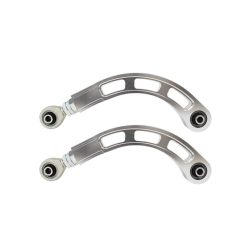
Net price: 100 €
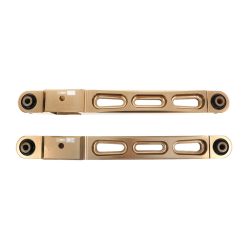
Net price: 150 €

Net price: 100 €
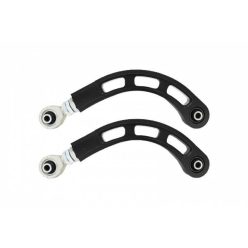
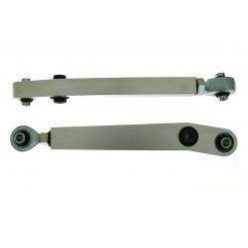
Net price: 112 €

Net price: 65 €
Mitsubishi control arms for secure grip and stable handling
Mitsubishi control arms are key rear suspension components that strongly influence handling, stability and tyre life. This category focuses on rear lower control arms and adjustable camber links for Lancer and Lancer EVO applications, available in several finishes and designs. They are well suited to full suspension overhauls, geometry correction on lowered cars and track-driven builds that demand precise alignment. Worn or bent control arms can quickly lead to unpredictable behaviour, longer braking distances and uneven tyre wear.
Technical Basics
A rear control arm connects the wheel hub to the subframe and defines baseline camber and toe settings. On performance Mitsubishi models the multi-link rear suspension is designed so that the wheel follows a carefully controlled path as the suspension moves, keeping the contact patch in the optimum position. Adjustable camber arms use threaded adjusters or spherical joints so alignment changes can be made in small, precise steps. Quality manufacturers such as TURBOWORKS and D1SPEC use appropriate material thickness and durable finishes to cope with the high loads seen in fast road and track use.
Excessive negative camber can destroy the inner shoulders of the tyres in a short time, while poor toe settings make the car nervous at speed and waste grip. On a lowered suspension the factory arms may no longer provide suitable geometry, so adjustable parts become essential. Strong steel or aluminium arms with well-executed welds and quality hardware will remain reliable even with semi-slick or slick tyres and aggressive driving. Regular inspection of bushes, joints and mounting points is critical, because neglected wear can turn a precise chassis into one that feels loose and unpredictable.
Selection Criteria
When choosing Mitsubishi control arms, start by identifying the exact model, generation and drivetrain layout, since a standard Lancer estate and an all-wheel-drive Lancer EVO use different arms. Think carefully about how you use the car: mainly street driving, a mix of road and track, or focused motorsport. Road-biased setups usually benefit from mild alignment changes and slightly firmer bushes, whereas competition cars often need more negative camber and stiffer joints. Choosing purely on price is risky; an under-engineered arm can bend or fail under track conditions.
With lowering springs or height-adjustable coilovers, camber arms allow you to restore sensible wheel angles while keeping the car visually and dynamically low. Wide, grippy tyres and larger brake kits increase the loads acting on the suspension, so you should favour reputable brands for such builds. For drift, time attack or autocross, it is important that the arms offer sufficient adjustment range while still locking securely under load. Poorly designed parts or incorrect wheel offset can also cause clearance issues, so alignment changes should always be checked for tyre-to-body and tyre-to-arm contact.
Installation & Maintenance
Installing Mitsubishi control arms demands clean mounting surfaces, correct hardware and adherence to the recommended torque sequence. Bolts should be tightened to the specified torque with the suspension close to normal ride height, so that rubber bushes are not pre-twisted at rest. It is wise to use new self-locking nuts and washers, as old fasteners may have fatigued. After installation a full wheel alignment is essential, especially with adjustable arms, because camber and toe values determine how stable the car feels and how quickly the tyres wear. Incorrect assembly can make even high-quality components perform poorly.
Routine maintenance involves checking each control arm for cracks, bent areas, loose lock nuts and play in bushes or spherical joints. After track days, heavy kerb strikes or large pothole impacts, the suspension should be inspected closely to ensure no arm has deformed and no settings have shifted. Steel surfaces benefit from periodic cleaning and corrosion protection so that steel arms remain structurally sound over the long term. If you notice odd noises, wandering behaviour or rapid tyre wear, the suspension should be investigated before the car is driven hard again, as a minor fault can escalate into a major failure at speed.
FAQ
When should I install adjustable rear arms on a Mitsubishi? Adjustable camber arms are recommended if the car is significantly lowered, fitted with wider tyres or used frequently on track. They allow you to restore sensible camber and toe settings and keep the car stable. Uneven tyre wear, unstable behaviour in corners or clunks from the rear suspension are strong signs that an upgrade or replacement is due.
Is a wheel alignment necessary after changing Mitsubishi control arms? Yes, a full wheel alignment should always be carried out after replacing control arms, especially when adjustable parts are installed. Small differences in length, bushing stiffness or installation position can change camber and toe. Driving without re-setting the alignment can lead to rapid tyre wear and reduced safety, particularly in wet or high-speed conditions.
Are performance Mitsubishi control arms suitable for daily driving? Quality performance control arms are suitable for everyday use as long as the alignment settings are not overly aggressive. Extreme negative camber or toe-in/toe-out values may be ideal on track but will quickly wear out tyres and can make the car nervous on poor road surfaces. For mixed use, choose moderate settings for daily driving and adjust further only for specific events.
What are the signs that Mitsubishi rear control arms need replacing? Common symptoms include clunking over bumps, the car pulling to one side under braking, a loose-feeling rear end and uneven tyre wear. When the car is raised, noticeable play at the control arm mounting points is another clear indicator. In such cases, replacement should not be delayed, and arms on the same axle are often best replaced in pairs.
How well do upgraded Mitsubishi control arms cope with track use? Well-designed performance arms from reputable brands are built for the higher loads associated with slick tyres, big brakes and repeated hot laps. Safety depends on correct installation, suitable fasteners and regular post-event inspections. Any sign of cracking, bending or excessive play means the parts should be replaced immediately rather than repaired or reused.
