
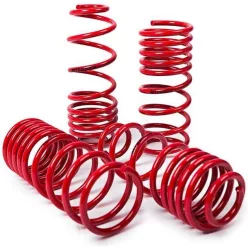
The MINI Cooper – MTS Technik lowering springs category mainly covers Mini (R50) and Mini (F56) chassis with dedicated lowering spring kits. Drop options between roughly 25 and 45 mm lower the centre of gravity, reduce body roll and give a noticeably sportier stance to these compact MINIs. Tuned for road use, MTS Technik springs sharpen handling while keeping everyday comfort at an acceptable level.

Net price: 116 €

Net price: 116 €

Net price: 116 €
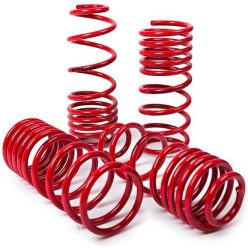
Net price: 124 €
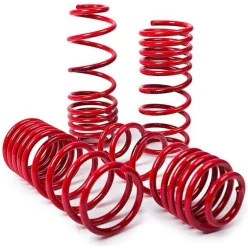
Net price: 153 €
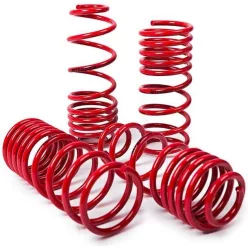
Net price: 153 €
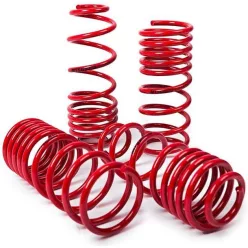
Net price: 127 €
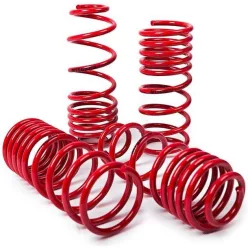
Net price: 148 €
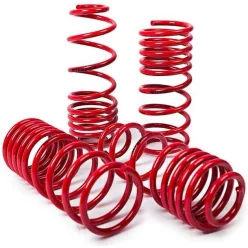
Net price: 148 €
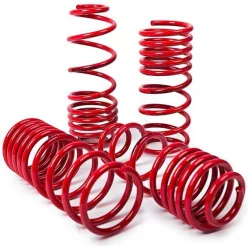
Net price: 127 €
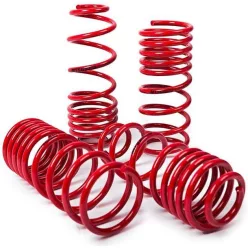
Net price: 148 €
Net price: 148 €
Benefits and applications of MINI Cooper lowering springs
The MINI Cooper – MTS Technik lowering springs are an excellent upgrade for drivers who want to enhance the already playful, go-kart-like handling of their MINI. Both the Mini (R50) and newer Mini (F56) generations come with relatively sporty factory suspension, but ride height is still set with comfort and ground clearance in mind. A suitable lowering spring kit drops the car by 25–45 mm, tightening body control and making steering responses feel more immediate. When specified sensibly, the car remains perfectly usable for daily commuting and longer journeys while looking and feeling much more purposeful.
Technical Basics
MTS Technik lowering springs use high-strength spring steel and robust corrosion-resistant coatings to withstand daily use and winter conditions. For Mini (R50) applications, multiple drop options exist, such as 25/25 mm, 30/30 mm and up to 45/45 mm, while Mini (F56) kits commonly provide drops around 30/25 mm. These figures show how much lower the front and rear axles sit compared with stock suspension, indicating how aggressive the final stance will be. A key warning is that larger 40–45 mm drops significantly reduce ground clearance, making careful driving over speed bumps, steep driveways and rough surfaces more important.
Selection Criteria
Choosing the right MINI lowering spring kit starts with confirming the correct generation, chassis code and engine type. A naturally aspirated Mini (R50) has different axle loads and suspension geometry from a turbocharged Mini (F56), so part numbers are not interchangeable. For daily street use, drops in the 25–30 mm range generally provide the most balanced result, improving stance and stability while keeping the car practical. More aggressive 40–45 mm setups suit enthusiasts who accept firmer ride quality and lower clearance in exchange for a more extreme look and sharper handling.
Installation & Maintenance
Installing lowering springs on MINI models should be handled by an experienced suspension workshop, as MacPherson struts and rear axles must be disassembled and reassembled safely. During the job, shock absorbers, top mounts, bushes and bump stops should be inspected and replaced if worn, because the firmer spring rates increase the loads on these components. A precise wheel alignment after installation is mandatory to restore correct toe and, where possible, camber settings, ensuring straight-line stability and even tyre wear. Regular inspections of spring coating, spring seats and suspension joints are recommended; any knocking noises or vague steering should be treated as a warning to have the system checked.
FAQ
How much should I lower a daily-driven MINI Cooper (R50)?
For an R50 used mainly on public roads, a drop of around 25–30 mm usually offers the best mix of handling improvement and everyday practicality. It noticeably sharpens turn-in and reduces body roll without making the car unmanageable over speed bumps and ramps. Larger 45 mm drops look more aggressive but demand more care in daily use.
Can I keep my OEM dampers with MTS Technik springs?
With a moderate 25–30 mm drop and healthy factory dampers, OE shocks can often be retained. For higher mileage cars or 40–45 mm drops, upgrading to sport dampers is recommended to maintain control and prevent bottoming out. Matching springs and dampers as a package typically provides the most consistent and durable setup.
How does comfort change on a Mini (F56) after lowering?
Lowering springs make the suspension firmer, so bumps and rough surfaces are felt more directly, especially with low-profile tyres. In exchange, the car rolls much less in corners, feels more stable under braking and delivers a more connected, go-kart-like driving experience. If ride comfort is a high priority, choose a moderate drop and avoid extreme wheel-and-tyre combinations.
Will lowering my MINI increase tyre wear?
Tyre wear can increase if the wheel alignment is not correctly adjusted after lowering, leading to excessive negative camber or unsuitable toe settings. With proper geometry and regular checks, tyre life can remain close to stock levels. Any rapid inner-edge wear or pulling should prompt an immediate alignment inspection.
Is approval required to lower a MINI Cooper for road use?
Requirements depend on your country’s local regulations and vehicle inspection standards. Using TÜV or ECE-approved springs and keeping the documentation in the car often simplifies inspections. When in doubt, consult an inspection station or suspension specialist familiar with modified MINIs.
