
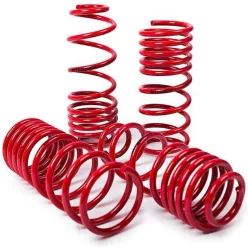
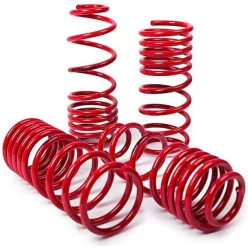
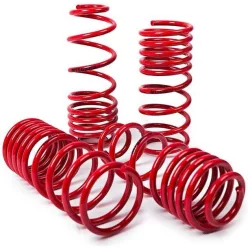
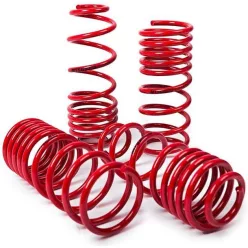
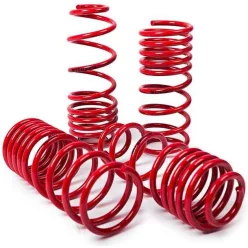
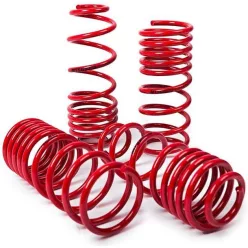
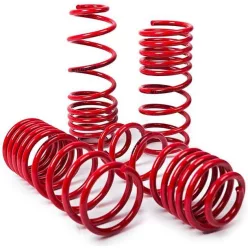
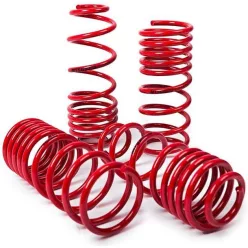
The Hyundai – MTS Technik lowering springs category provides dedicated kits for Accent I–III, Atos, Coupe (GK) and other Hyundai models. Depending on the application, drop values range from around 30 to 60 mm, giving a sportier stance and more stable cornering. Each MTS Technik lowering spring kit is matched to the original axle loads, helping the car feel more planted without sacrificing everyday usability.

Net price: 179 €

Net price: 193 €

Net price: 179 €

Net price: 172 €
Net price: 135 €
Net price: 193 €
Net price: 166 €
Net price: 201 €
Net price: 201 €
Net price: 166 €
Net price: 150 €
Net price: 124 €
Benefits and applications of Hyundai lowering springs
The Hyundai – MTS Technik lowering springs upgrade the handling of Accent, Atos and Coupe (GK) models by tightening up their generally soft factory suspensions. Standard setups prioritise comfort and ground clearance, which is useful on poor roads but can lead to noticeable body roll at higher speeds. A well-chosen lowering spring kit reduces the centre of gravity, making the car more stable in bends and during quick lane changes while also improving overall appearance. Because these kits are tuned for road use, ride quality remains acceptable as long as the drop is chosen sensibly for local conditions.
Technical Basics
MTS Technik lowering springs are produced from high-strength spring steel and treated with robust protective coatings to resist corrosion. Dedicated kits are available for Hyundai Accent I, Accent II, Accent III, Atos and Coupe (GK), with drop options such as 30/30 mm, 40/40 mm and 60/60 mm. These values describe the front and rear ride-height reduction relative to stock suspension. A key warning is that large 60 mm drops substantially reduce ground clearance, so drivers must be particularly careful over speed bumps, potholes and steep driveways.
Selection Criteria
Choosing the right Hyundai lowering spring kit begins with identifying the exact model, year, engine and body style. The different axle loads and suspension layouts of Accent I–III, Atos and Coupe (GK) make it essential to use a chassis-specific kit rather than a generic solution. Decide whether you want a mild 30–35 mm drop for daily driving or a more pronounced 40–60 mm drop for a sportier stance. For cars used on mixed or rough roads, a 30–35 mm drop usually offers the best balance, whereas larger drops are more suitable where road quality is high and wheel and tyre sizes are chosen carefully.
Installation & Maintenance
Installation of lowering springs requires safe disassembly of MacPherson front struts and the rear axle or multi-link assemblies, so the work should be carried out by an experienced workshop. After fitting, a precise wheel alignment is mandatory to restore correct toe and, where possible, camber settings, ensuring straight-line stability and even tyre wear. Regular checks of spring coating, top mounts, bushes and shock absorbers are recommended, as firmer springs place greater loads on these parts. An important warning is that if the car feels bouncy, unstable or starts knocking after lowering, it should not be driven hard until the suspension has been inspected.
FAQ
What drop is suitable for a daily-driven Hyundai Accent?
For most daily-driven Accents, a 30–35 mm drop provides a clear handling improvement and sportier stance while retaining enough clearance for typical road obstacles. Larger 60 mm drops look more aggressive but are better suited to good-quality roads and experienced drivers. Always check clearance with the car fully loaded.
Can I keep my stock Hyundai shock absorbers?
With a moderate 30–35 mm drop and healthy OE dampers, original shocks can often be used with MTS Technik springs. For 40–60 mm drops, sport dampers are strongly recommended to prevent the shocks from operating at the end of their stroke and to avoid bottoming out. Using worn shocks with stiffer springs will quickly highlight any existing issues.
How does comfort change on a Hyundai Coupe (GK) after lowering?
Lowering springs make the Coupe feel noticeably firmer, especially when combined with low-profile tyres, so bumps are transmitted more directly into the cabin. In return, cornering becomes more controlled, body roll is reduced and high-speed stability improves. A moderate drop is recommended if you regularly do long journeys or drive on uneven surfaces.
Will lowering my Hyundai increase tyre wear?
Tyre wear can increase if the alignment is not corrected after lowering, typically through excessive negative camber or unsuitable toe settings. With proper geometry and periodic checks, tyre life can remain similar to stock. Any signs of rapid or uneven wear should prompt an immediate alignment check.
Is approval required to lower my Hyundai for road use?
Legal requirements differ between countries, so you should always check relevant local regulations and inspection rules before modifying your suspension. TÜV or ECE-approved springs are often easier to register, and keeping the documentation in the car is advisable. For certainty, consult an inspection station or suspension specialist experienced with Hyundai models.
