
In the Fuel & Oil Hose Finisher Clamps (Finisher Clamp) category you’ll find TurboWorks aluminium hose-end parts that are listed for rubber and nylon hoses in fuel, oil or water systems (check each product page for exact fitment).
Use the AN-4–AN-10 sizing and the ID (mm) shown in the product name to narrow your choice, then sort the list and open a product card to confirm specifications. Pick the correct option for your hose and add it to your basket.


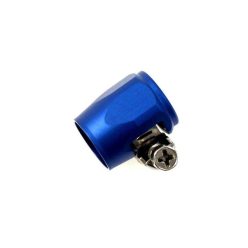

Net price: 4 €

Fuel & Oil Hose Finisher Clamps (Finisher Clamp) – tidy hose ends, easier servicing and clearer identification
Finisher clamp hose-end parts are used at the end of a hose to create a neat, stable finish around the termination point and improve handling during installation. Based on the product descriptions in this category, the range is aluminium and intended for rubber and nylon hoses in fuel, oil or water systems, provided the specific product specification matches your application.
You’ll see multiple AN sizes (for example AN-4, AN-6, AN-8, AN-10), and the product name also shows ID (inner diameter) in mm to speed up selection. Both “finisher clamp” and hex finisher styles appear, which can matter for tool access, clearance and serviceability in tight engine bays.
For track, drift or tuned street cars, hose routing and termination quality affects reliability: leaks, chafing and movement usually start at junctions. A finisher clamp does not replace proper hose rating and correct fittings, so always validate compatibility and manufacturer specs for the whole assembly.
Technical Basics
A finisher clamp here is a hose-end element used at the hose tip to provide a controlled finish and a more robust termination area. This differs from a classic hose clamp used to secure a hose over a barb or spigot; the two solutions are not interchangeable. Match the part type to your hose termination method.
The product descriptions list TurboWorks aluminium parts and state they are for rubber and nylon hoses. On fuel systems, chemical compatibility depends on the hose construction and what you run (petrol blends, additives), so the hose spec is as important as the hose-end itself. If your build uses PTFE-lined hoses, only choose an option that explicitly supports that hose type.
AN markings help you navigate the size family, but final fit depends on the hose dimensions and the stated ID in mm. If you pair these with other standards (for example JIC 37° fittings elsewhere), confirm the entire chain—hose, hose end, fitting, sealing method—matches the intended standard and size.
Warning: after any fuel-line work, perform a careful leak check and, where appropriate, a controlled pressure test.
Selection Criteria
Start with measurements: confirm the hose’s real dimensions, then use the product-name ID (mm) to shortlist options and only then decide within AN-6 / AN-8 / AN-10 families. Example IDs shown in the catalogue (such as ID 16 mm or ID 21 mm) are there to speed up matching, but your hose data sheet should be the final reference. If the hose has an extra jacket or thicker wall, ID-based selection becomes even more important.
Choose the form factor for access: hex finisher can help where a wrench grip is needed, while a smoother finisher clamp profile may reduce the chance of rubbing against nearby components. Think about service intervals—quick inspections and easy hose removal are valuable on track builds. Keep routing, heat exposure and chafe protection in mind.
For daily use, prioritise long-term stability: select a hose-end that clearly states hose material compatibility and remains stable through heat cycles. If anything is unclear, open the product page and verify rubber vs nylon and the intended system (fuel/oil/water).
Installation & Maintenance
Good results start with prep: make a clean, square cut, remove burrs and keep debris out of the hose. After fitting the hose end, confirm the hose is not twisted and that the termination sits straight, then run a careful leak check at operating conditions where safe. Any seepage or smell means you should stop and re-check the assembly.
For maintenance, inspect for wetness, odour, cracks and any movement at the joint. Heat cycling can reveal marginal assemblies, so re-check after the first few runs, especially on high-heat engines or track use. When in doubt, follow the product specification and the hose manufacturer’s guidance.
FAQ
Which size do I need for AN-8?
AN-8 alone is not enough—use the ID (mm) shown in the product name and compare it with your hose dimensions. If your hose has an outer jacket or unusual construction, the ID match is what prevents a loose or overly tight fit. Confirm against the hose data sheet before ordering.
Can I use these with PTFE (Teflon) hose?
The descriptions in this category mention rubber and nylon, so only use them with PTFE if the specific product page explicitly states compatibility. PTFE hoses often need different termination hardware due to the liner and braid structure. Always check the exact hose type and spec.
How is this different from a regular hose clamp?
A regular hose clamp typically secures a hose over a barb, while a finisher clamp here is a hose-end element used at the hose tip. They solve different problems, so you should not substitute one for the other. Match the part to your termination design.
Is it safe for fuel lines?
Fuel safety depends on the full system: hose rating, correct fittings, proper installation and verification. The product descriptions list fuel-system use, but you still need to confirm the exact hose material and the product’s intended application. Always perform a leak check after installation.
What should I check after installation?
Look for leaks first (wetness, smell), then confirm the hose end hasn’t shifted under load or heat. Where appropriate, a controlled pressure test can prevent issues before road or track use. Re-check after a few heat cycles.
Filter by size and compatibility, then choose the right hose-end option and place your order.
