
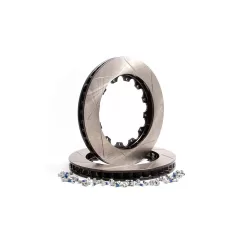
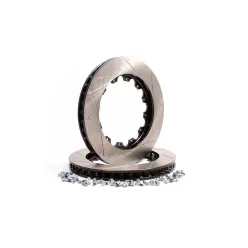
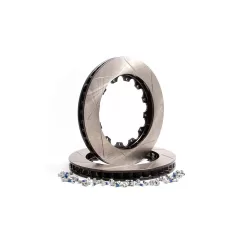
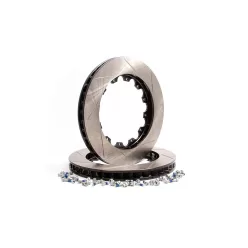
Forge Motorsport brake discs are high-performance, two-piece floating rotors developed specifically for Forge big brake kits. CNC-machined forged aluminium hats are combined with proprietary high-strength iron rings featuring directional curved vanes for optimum cooling. The slotted friction surface improves bite and pad de-gassing, making these discs ideal for fast road, track day and time attack use where consistent performance and reduced unsprung mass are crucial.
Net price: 1 202 €
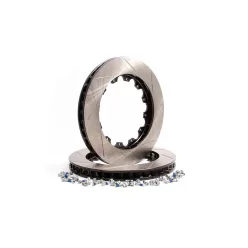
Forge Motorsport brake discs for big brake kits
Forge Motorsport brake discs are designed as direct replacement rotor rings for Forge big brake kits, offering a significant upgrade in thermal capacity and consistency over stock components. Available in sizes around 330 x 32, 356 x 32 and 380 x 32 mm, these discs deliver increased brake torque and better heat management on powerful road cars and track builds. The forged aluminium hats and high-strength iron rings are optimised to withstand repeated hard use without excessive warping or fade.
Technical Basics
A typical Forge Motorsport disc consists of a CNC-machined, forged aluminium hat bolted to a proprietary high-carbon iron rotor. Directional curved cooling vanes draw air from the centre outwards, improving cooling compared to straight vanes and helping to delay the onset of brake fade. The slotted friction surface constantly refreshes the pad contact area by evacuating dust and gases, which maintains a high and stable coefficient of friction during aggressive braking.
The two-piece floating mounting system allows the iron ring to expand with heat independently of the aluminium hat, reducing stress and minimising the risk of distortion. This also cuts unsprung weight compared with a one-piece cast disc, improving steering feel and suspension response, particularly on cars running large 356–380 mm rotor diameters. The discs are available for both front and rear axles in matching sizes so that overall brake bias and ABS/ESC behaviour remain predictable.
Because the rotor rings are separate from the hats, long-term running costs are reduced: once the ring is worn to minimum thickness, only the iron section needs replacing, while the lightweight aluminium hat can be re-used. Minimum disc thickness is typically around 29 mm for these 32 mm rotors, and operating below this limit is not recommended. Always confirm the exact specification for your particular Forge kit before use.
Selection Criteria
When choosing Forge Motorsport brake discs, the most important rule is that they are intended only for compatible Forge big brake kits. Each part number – such as 330 x 32 mm, 356 x 32 mm or 380 x 32 mm replacements – corresponds to a specific caliper and hat combination. You should always verify the existing kit code, rotor size, bolt pattern and offset, as these discs are not a universal fit for OEM calipers or other brands.
Your intended use strongly influences the optimal disc size and pad combination. For fast road and occasional track days, a 330 x 32 or 356 x 32 mm two-piece rotor with a suitable sport pad compound is often sufficient, providing a clear step up from OEM brakes. Dedicated track or time attack cars, especially heavier or highly tuned turbo models, usually benefit from the larger 380 x 32 mm discs paired with more temperature-resistant pads and high-boiling-point brake fluid.
Pad choice is critical for getting the best from Forge Motorsport rotors. A mid-aggressive fast road/track pad offers a good balance of cold bite, noise and dust for mixed use, while full race pads deliver outstanding high-temperature performance at the cost of more dust and noise when cold. It is also important to ensure your brake fluid and lines are upgraded to match; high-performance discs cannot compensate for faded fluid or expanding rubber hoses.
Installation & Maintenance
Correct installation of Forge Motorsport brake discs is essential for reliability and comfort. The hub and hat mounting faces must be thoroughly cleaned of rust, dirt and old deposits so that the discs sit perfectly flat. Rotor-to-hat bolts should be tightened to the specified torque value (typically around 14 Nm where stated) and secured according to Forge’s instructions. After installation, disc run-out should be checked with a dial gauge to minimise the risk of vibration and uneven pad deposits.
Every new disc and pad combination requires a proper bed-in procedure. This involves a series of progressively harder stops from medium speeds, building heat gradually so that an even transfer layer of pad material is laid down on the rotor surface. Skipping this step, or performing full-force stops straight away, can cause hotspots, uneven deposits, discolouration and premature cracking, especially on large-diameter performance discs.
Ongoing maintenance includes regular inspection of disc thickness, as well as the rotor surfaces for deep grooves, heavy heat checking or blue discolouration. After track days or extended mountain driving, it is good practice to examine both discs and pads for signs of overheating or abnormal wear. If you notice pedal pulsation, vibration through the steering wheel or unusual noises under braking, check hub cleanliness, run-out and mounting hardware – continued operation with such symptoms can damage not only the discs but also calipers, wheel bearings and suspension components.
FAQ
Are Forge Motorsport brake discs compatible with OEM brake systems?
No, Forge Motorsport brake discs in this category are designed as replacement rotor rings specifically for Forge big brake kits. They generally will not fit directly onto OEM calipers or hats, as the diameters, offsets and bolt patterns are tailored to Forge hardware. Always confirm compatibility using the exact kit and rotor part numbers.
What is the advantage of two-piece Forge Motorsport discs over one-piece discs?
The two-piece floating design uses a lightweight aluminium hat and a separate iron rotor ring, which reduces unsprung mass and improves cooling. This lowers the risk of warping and fade under repeated hard braking, while also allowing the iron ring to be replaced separately when worn. Overall, you get more consistent braking and potentially lower long-term running costs.
What minimum thickness should I observe on Forge Motorsport brake discs?
Most 32 mm thick Forge rotors have a minimum recommended thickness of around 29 mm, below which the disc should not be used. Operating under this limit can reduce strength and increase the risk of cracking, especially during heavy track use. Always refer to the specific documentation for your kit to confirm the exact minimum value.
Which brake pads work best with Forge Motorsport rotors?
For mixed road and track driving, a mid-aggressive sport pad with good high-temperature capability is usually ideal. Dedicated track and race cars benefit from full competition compounds, which maintain friction at very high temperatures but tend to be noisier and more abrasive when cold. Matching the pad’s temperature range to your actual usage is the key to performance and disc life.
Do I have to bed in new Forge Motorsport discs and pads?
Yes, all new discs and pads should be bedded in using a structured series of moderate-to-hard stops. Proper bedding creates an even transfer layer on the disc face, which helps to prevent judder and hotspots and extends both pad and rotor life. Skipping this process can significantly compromise performance and comfort.
How often should I inspect or replace Forge Motorsport brake discs?
Inspection intervals depend on usage: fast road cars may only need periodic visual checks and thickness measurements, while track cars should be inspected after each event. If Forge discs show deep grooves, extensive cracking, severe discolouration or have worn close to minimum thickness, the rotor rings should be replaced. Replacing them in time is cheaper than risking damage to pads, calipers or other components.
