
Ford – MTS Technik Suspension Kits deliver vehicle-specific, height-adjustable spring–damper sets for daily and spirited driving. Threaded adjusters provide precise ride-height control, while matched damping reduces pitch/roll for cleaner cornering. When choosing, confirm axle loads, body style (hatch/saloon/estate) and drivetrain (FWD/AWD; ST/RS; V8).
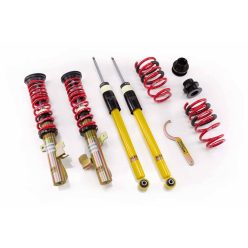
Net price: 721 €
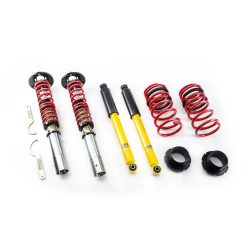
Net price: 775 €
Brief summary & key benefits
Ford – MTS Technik kits aim to sharpen handling while preserving daily comfort. A sensible drop lowers the centre of gravity, reducing pitch and roll so the chassis stays calmer under braking and cornering. Vehicle-specific tuning, robust anti-corrosion finishes and quality bushings deliver consistent performance across seasons.
Technical Basics
Each kit pairs tailored steel springs with gas-charged dampers. A threaded body with locking collars enables precise per-axle ride-height changes within the approved range. Depending on application, spring behaviour may be linear for direct feedback or dual-rate/progressive for better small-bump compliance. Heat-stable oil, reliable seals and dust boots maintain damping consistency; outer surfaces use corrosion-resistant coatings.
Ford specifics: drivetrain and engine variants (FWD/AWD, EcoBoost, V6/V8) change axle loads and thus the ideal spring/damper window. Hotter trims like ST/RS typically benefit from optional camber plates to fine-tune front grip and tyre wear. RWD/V8 applications (e.g., Mustang) require attention to rear traction and bump travel under load.
Selection Criteria
Use case — For road-biased builds start near mid-range height to preserve travel and alignment freedom; for occasional track days a slightly lower stance is acceptable if clearance and travel remain adequate.
Body & drivetrain — Hatch/saloon/estate bodies distribute mass differently; AWD adds front-axle weight. Always choose the kit for your exact body/engine/drivetrain combination.
Tyres & wheels — Larger wheels and shorter sidewalls raise bottom-out risk; adapt ride height and check bump stops. For semi-slicks, consider higher spring rates with appropriate damping changes.
Geometry — After lowering, perform a full four-wheel alignment (camber/toe/caster). Excessive negative camber accelerates inner tyre wear; camber plates help fine-tune the balance where available.
Installation & Maintenance
Have the kit installed by an experienced shop. Replace worn top mounts, check dust boots and bump stops. Clean threads and apply light anti-seize so later adjustments are easy; torque all fasteners to spec and preload rubber bushes at ride height. After a shakedown, re-torque and align.
For longevity, periodically wash threads, refresh anti-corrosion spray and verify that lock collars remain secure. Any knocking, oil traces or pogo-like behaviour warrants immediate inspection of dampers and mounting points. Keep a written baseline (height/damping) so you can revert between road and track settings.
FAQ
Q: How low can I go safely?
A: Stay within the manufacturer’s approved range to preserve travel and geometry.
Q: Is alignment required after installation?
A: Yes — lowering alters geometry; set camber/toe/caster correctly after fitting and major height changes.
Q: What baseline settings should I start with?
A: Begin at mid-range height and the recommended damping baseline; fine-tune in small steps.
Q: Are cold-weather noises normal?
A: Slight NVH increases are common with firmer bushings; persistent knocking needs inspection.
Q: Do I need adjustable top mounts?
A: Useful for precise camber control and front-end grip on ST/RS or track-focused setups (where available for your model).
