
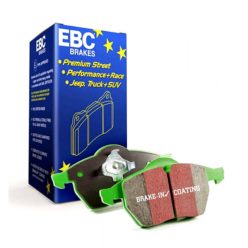
EBC Greenstuff brake pads are high-friction organic street compounds designed to upgrade braking on lighter and medium-weight cars. The pads offer around a 0.55 nominal friction coefficient, stable performance up to roughly 600–650 °C and a medium, easy-to-clean brake dust level. Thanks to their deliberately softer, rotor-friendly mix and the red Brake-In surface coating, Greenstuff pads deliver strong initial bite and reassuring pedal feel from the very first kilometres.
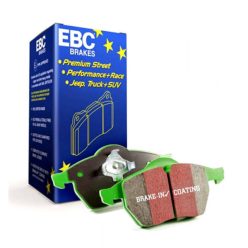
Net price: 112 €
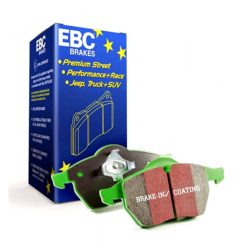
Net price: 128 €
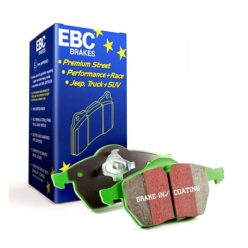
Net price: 85 €
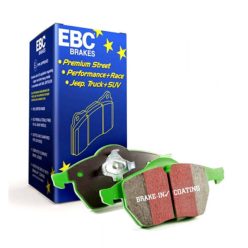
Net price: 105 €

Net price: 133 €

Net price: 103 €

Net price: 98 €

Net price: 89 €

Net price: 122 €

Net price: 90 €
Net price: 171 €

Net price: 126 €
EBC Greenstuff brake pads – fast road upgrade for lighter cars
EBC Greenstuff brake pads are aimed at drivers who want a noticeable improvement in stopping power over stock pads, without sacrificing everyday comfort. On lighter and medium-weight vehicles, Greenstuff typically delivers a significant braking performance increase and shorter stopping distances compared with OE-type friction materials. The compound provides strong initial bite, progressive torque and a reassuring pedal feel, making it ideal for normal and spirited street driving, occasional mountain runs and motorway use.
The friction material is based on high-friction aramid fibres in an organic formulation, with a nominal friction coefficient around 0.55 and an effective operating range up to about 600–650 °C. This gives plenty of headroom for repeated hard stops in demanding road conditions, without excessive fade. At the same time, Greenstuff pads are designed as medium-dust, rotor-friendly components: dust output is lower than many generic aftermarket pads, the dust is easier to wash off, and disc wear remains modest for a performance upgrade pad.
Technical Basics
The Greenstuff family comprises several series for different vehicle types. The well-known Greenstuff 2000 series is a sport street upgrade for lighter passenger cars and hot hatches, while the Greenstuff 6000 and 7000 lines are tuned for SUVs, 4x4s and light trucks that see mixed urban and highway duty. Many Greenstuff part numbers carry full ECE R90 approval, which means that in those applications they are legally approved for public-road use throughout the EU, even though they deliver a higher friction level than typical OE pads.
All automotive EBC Greenstuff brake pads feature the manufacturer’s red Brake-In™ surface coating, which helps strip glaze and light ridges from used discs and accelerates the bedding-in process after installation. Chamfered edges and a central vent groove help control noise, reduce the risk of edge crumbling and allow gases and debris to escape the pad–disc interface. Noise-damping shims on the back plate further improve comfort, and the relatively soft compound keeps disc wear low for this performance category – at the cost of not being suitable for sustained track or race use.
Selection Criteria
When choosing EBC Greenstuff pads, start by identifying the exact pad shape and part number from the vehicle’s make, model, year, engine and axle position (front or rear). Catalogues and selector tools list all compatible applications for each DP code. It is important to understand that Greenstuff is optimised for lighter and mid-weight vehicles used mainly on the road; for very heavy or high-power cars, or for frequent high-speed runs, EBC generally recommends moving up to Redstuff or Yellowstuff compounds.
Think carefully about how the car is used: mostly city commuting, mixed town and motorway, long downhill passes, or occasional spirited driving on B-roads. On a typical hot hatch or compact saloon up to roughly 1200 kg, Greenstuff is often the ideal “first step” performance pad, giving a clear improvement over stock without excessive noise or harshness. If the car runs sticky semi-slick tyres, carries heavy loads or regularly tows, the brake system will see more heat, and a higher-grade compound such as Redstuff or Yellowstuff may provide a larger thermal safety margin.
Installation & Maintenance
Fitting Greenstuff brake pads follows the same good-practice rules as any quality performance pad. Discs should be within thickness limits and free from deep cracks, heavy lips or severe run-out, while the hub and disc mounting faces must be perfectly clean and free from corrosion. During installation, always clean and lightly lubricate the caliper slide pins and pad contact points with a suitable high-temperature brake grease. Caliper bolts must be tightened to the vehicle manufacturer’s specified torque settings to avoid loosening or thread damage.
After fitting, it is wise to bleed the system with fresh, high boiling point brake fluid, as even fast-road compounds can generate substantial heat during hard use. Correct bedding-in is critical: for the first few hundred kilometres, avoid prolonged, maximum-effort stops and instead perform a series of progressively harder decelerations from moderate speed. Do not keep the car stationary with the pedal firmly depressed while the brakes are extremely hot, as this can lead to uneven pad material transfer, disc thickness variation and brake judder. Periodic checks of pad thickness and disc condition help catch overheating or abnormal wear early.
FAQ
Are EBC Greenstuff brake pads suitable for daily driving?
Yes. Greenstuff pads are specifically designed for normal and fast road use on lighter and medium-weight vehicles. They offer a clear performance gain over stock pads while keeping noise, comfort and dust at levels most drivers find acceptable for day-to-day use.
Can I use Greenstuff pads for trackdays?
While Greenstuff can cope with occasional hard stops, it is not intended as a dedicated track compound. Under sustained circuit use – especially on heavy or powerful cars with grippy tyres – brake temperatures may exceed its comfort zone, leading to fade. For regular trackdays, EBC recommends more aggressive compounds such as Yellowstuff or Bluestuff, or full race pads.
Do Greenstuff pads create more or less dust than stock pads?
According to the manufacturer, EBC Greenstuff generates low to medium dust levels, generally lower than many generic aftermarket pads, and the dust is easier to wash off the wheels. However, there is no such thing as a completely dust-free pad: some dust generation is necessary for smooth, quiet braking and to prevent disc vibration.
Will Greenstuff pads wear out my brake discs faster?
Greenstuff compounds are deliberately formulated as relatively rotor-friendly materials, so disc wear is usually comparable to, or only slightly higher than, that seen with good OE pads. Ensuring that discs are in good condition, bedding-in is done correctly and operating temperatures remain within the intended range will all help keep disc wear under control.
Are EBC Greenstuff pads road-legal in the EU?
Road legality depends on whether the specific part number is ECE R90 approved for your vehicle. Many Greenstuff applications carry this homologation and are therefore fully legal for public-road use across the EU, while some race-oriented references may not. Always check the approval status for the exact pad code fitted to your car before using it on public roads.
When should I choose Greenstuff instead of Redstuff or Yellowstuff?
Choose Greenstuff if your priority is a strong but civilised fast-road pad for a lighter or medium-weight car, with good cold bite and modest dust. If you drive a heavier, more powerful vehicle, tow frequently or do a lot of high-speed motorway work, Redstuff may be more appropriate. For frequent trackdays and very high thermal loads, Yellowstuff, Bluestuff or race pads are usually the better option.
