
EBC Yellowstuff brake pads are high-friction fast street compounds developed for more powerful or heavier cars and occasional light track use. The material offers a stable friction level of around 0.48–0.5 μ up to roughly 450 °C, with many part numbers carrying full ECE R90 approval for road use. Yellowstuff is a strong choice if you want a noticeable braking upgrade and good cold bite, but still need everyday usability rather than a pure race pad.

Net price: 184 €

Net price: 159 €

Net price: 246 €

Net price: 276 €
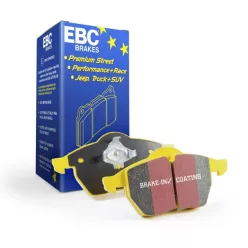
Net price: 168 €
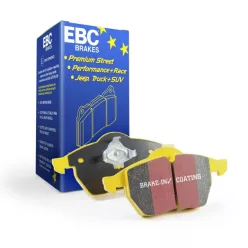
Net price: 198 €
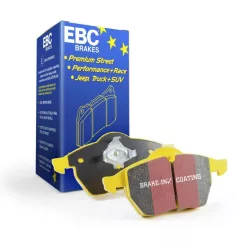
Net price: 229 €
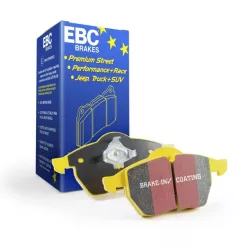
Net price: 292 €
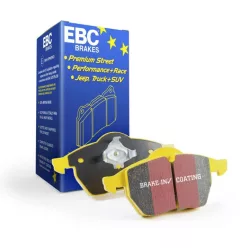
Net price: 297 €
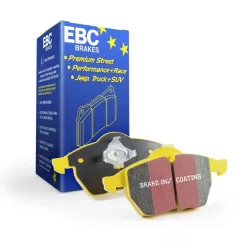
Net price: 200 €
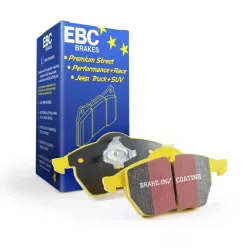
Net price: 188 €
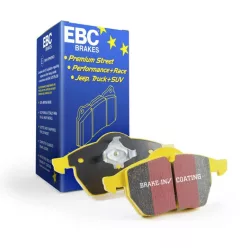
Net price: 254 €
EBC Yellowstuff brake pads – fast street performance with light track capability
EBC Yellowstuff brake pads are among EBC’s best-known fast street compounds, designed for higher-powered, heavier vehicles where maximum stopping power and repeated hard braking are part of everyday use. Compared with typical OE pads, Yellowstuff delivers a clear increase in stopping performance and shorter braking distances, especially from higher speeds, while retaining good manners and strong cold bite for daily driving. Many Yellowstuff references are fully ECE R90 approved, making them legal OE-equivalent upgrades in their specified applications across the EU.
Manufacturer data indicate a nominal friction coefficient of around 0.48–0.5 μ for Yellowstuff, remaining stable up to approximately 450 °C. EBC’s current messaging positions Yellowstuff primarily as a fast road pad: it can tolerate occasional, short track sessions, but for sustained, high-temperature circuit work the company now recommends Bluestuff NDX or the RP-series race compounds. Even so, Yellowstuff remains popular in fast road cars, police vehicles and lighter race cars, where peak temperatures stay within its comfort zone.
Technical Basics
The Yellowstuff compound is a high-friction, largely non-metallic formulation with a GG friction rating, meaning it maintains a “high” μ level both cold and hot in standardised tests. EBC quotes a stable friction of around 0.48–0.5 μ up to roughly 450 °C, providing strong, consistent braking during repeated hard stops in demanding road conditions. The pad has a so-called green fade threshold around 400 °C, above which the resins fully cure and the pad is ready for high-temperature use.
Recent versions of Yellowstuff use a copper-free formula to comply with modern environmental regulations, while retaining the performance and durability of earlier generations. All Yellowstuff pads feature EBC’s red Brake-In™ surface coating, designed to clean off light glaze and ridges on used rotors and accelerate the bedding-in process. Chamfered edges, a central vent groove and noise-reducing shims on the backing plates help minimise vibration and noise, giving Yellowstuff a refined feel for a pad in this performance category.
Selection Criteria
When choosing EBC Yellowstuff pads, start by identifying the correct part number from your vehicle’s make, model, year, engine and axle position (front or rear). Yellowstuff is aimed primarily at faster hot hatches, performance saloons and coupes, and heavier cars with power outputs around or above 200 bhp, where repeated high-speed braking is common. On lighter, modestly powered cars, Greenstuff is often sufficient, while for very heavy or extremely powerful vehicles used hard on track, Bluestuff or the RP compounds may be more appropriate.
Consider how the car is used in practice: mostly urban and motorway driving with occasional spirited runs, or regular mountain passes and trackdays. If your usage is mainly fast road with only short, infrequent track sessions, Yellowstuff offers an excellent balance of cold bite, heat capacity and ECE R90 road legality. If you expect long stints on circuit or very high brake temperatures, stepping up to Bluestuff NDX, Orangestuff or RP-series race pads will provide a larger thermal safety margin and more consistent performance at the limit.
Installation & Maintenance
Installing EBC Yellowstuff pads should follow the same thorough procedures used for other performance friction materials. Brake discs must be above the minimum thickness, and free from severe cracks, heavy lips or major run-out. The hub and disc mounting faces should be cleaned back to bright metal so the rotor runs true, minimising vibration and uneven wear. Caliper slide pins or guides and pad contact points need to be cleaned and lightly lubricated with a high-temperature brake grease, and caliper bolts must be tightened to the vehicle manufacturer’s specified torque settings.
Because Yellowstuff can generate more heat than OE pads, a good-quality DOT 4 or DOT 5.1 brake fluid is recommended, especially on cars that see heavy motorway use or occasional trackdays. Proper bedding-in is critical: carry out a series of progressively harder stops from moderate speed and avoid holding the car stationary with very hot brakes applied. Poor bedding can lead to brake fade, uneven pad deposits and judder, issues that are harder to cure once established. Regularly check pad thickness, disc condition and pedal feel; any unusual changes in travel or vibration should be investigated immediately.
FAQ
Are EBC Yellowstuff brake pads suitable for daily driving?
Yes. Yellowstuff pads are designed as high-performance fast street pads and work well in normal daily use, offering strong cold bite and a clear performance gain over many OE pads. They are particularly well suited to heavier or more powerful cars that see frequent high-speed braking on the road.
Can I use Yellowstuff pads for trackdays?
Yellowstuff can cope with occasional, short track sessions, especially on lighter cars, and has a long history in club-level motorsport. However, EBC’s current recommendation is to treat Yellowstuff mainly as a fast road pad and to use Bluestuff NDX or RP-series compounds for sustained, high-temperature circuit work. If you attend regular trackdays, a more track-focused compound is usually a better choice.
Do Yellowstuff pads need to be warmed up?
One advantage of Yellowstuff brake pads is that they provide 100% braking from cold, so they are safe and effective in normal road use without pre-warming. That said, performance improves further as the pads reach their working temperature range, so a few medium stops before pushing hard on track or fast road runs is still good practice.
How much dust do EBC Yellowstuff pads produce?
Dust levels from Yellowstuff are typically similar to OE pads or slightly higher, reflecting the pad’s higher friction level and performance focus. They are not marketed as low-dust pads – that role is covered by EBC’s Redstuff ceramic range – but most users find the dust output acceptable given the significant increase in stopping power.
Are Yellowstuff pads road-legal in the EU?
Many Yellowstuff part numbers are fully ECE R90 approved, which means they are type-approved as OE-equivalent pads and can be used legally on public roads throughout the EU in those applications. Always check that the specific DP code you plan to fit is R90 approved for your vehicle before using it on the road.
How does Yellowstuff compare to Greenstuff, Redstuff and Bluestuff?
Greenstuff is aimed at lighter cars needing a modest fast-road upgrade, while Redstuff ceramic targets heavier, powerful road cars with a strong focus on low dust. Yellowstuff sits above both as a high-friction fast street pad with some light track capability, and Bluestuff goes a step further towards dedicated track and race use with even higher thermal capacity and a more track-focused character.
