
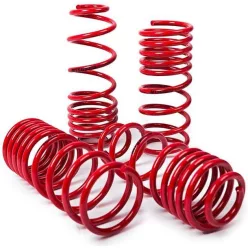
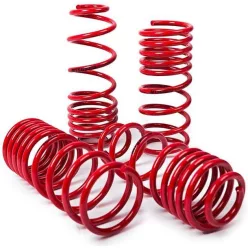
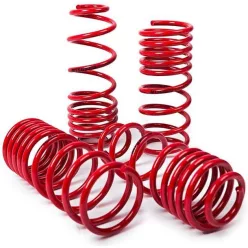
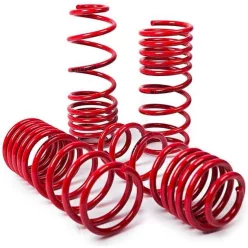
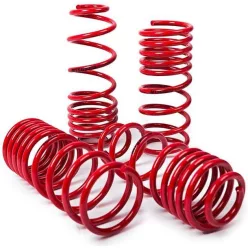
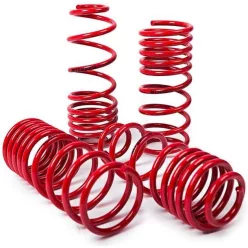
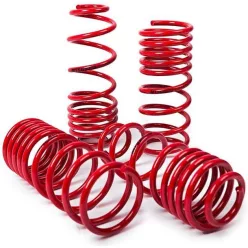
The Daihatsu – MTS Technik lowering springs category includes chassis-specific kits for Charade, Cuore, Applause, Materia, Sirion and other Daihatsu models. Drop options between 30 and 60 mm give a clearly sportier stance and reduce body roll without turning these light cars into uncomfortable track-only builds. MTS Technik springs are tuned to suit the compact Daihatsu platforms, balancing sharper handling with everyday usability.
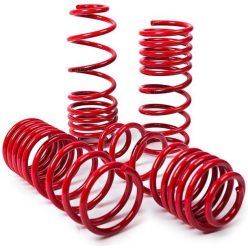
Net price: 140 €

Net price: 156 €
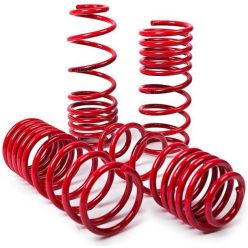
Net price: 139 €
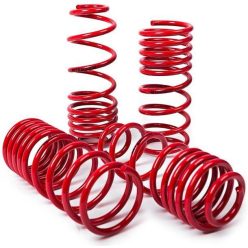
Net price: 142 €
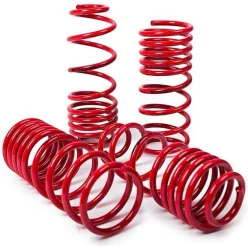
Net price: 116 €
Net price: 156 €
Net price: 121 €
Net price: 124 €
Net price: 153 €
Net price: 153 €
Net price: 166 €
Net price: 161 €
Benefits and applications of Daihatsu lowering springs
The Daihatsu – MTS Technik lowering springs are an excellent match for compact Japanese models such as Charade, Cuore, Sirion and Materia. On these cars the stock suspension is often relatively high and soft to maintain comfort on city streets and rougher roads. A carefully chosen lowering spring kit drops the centre of gravity, improves cornering stability and makes the car feel more planted at speed. With drop options from 30 to 60 mm, you can choose anything from a mild fast-road setup to a more aggressive visual stance, depending on your priorities.
Technical Basics
MTS Technik lowering springs are produced from high-strength spring steel with specialised protective coatings for long-term corrosion resistance. Daihatsu-specific applications are tuned for the relatively light chassis and different engine options, so a Cuore II receives different rates from a heavier Materia or Applause. Drop figures listed in the catalogue – such as 30/30 mm, 35/35 mm, 40/40 mm or even 60/30 mm – describe front and rear lowering relative to stock. A key warning is that larger 50–60 mm drops significantly reduce ground clearance, so you must take extra care around speed bumps, potholes and steep ramps.
Selection Criteria
Choosing the correct Daihatsu lowering spring kit starts with identifying the exact model, chassis code, year and engine (for example Charade III/IV, Cuore II–V, Sirion I). The catalogue’s drop values clearly indicate how much lower the car will sit at each axle, allowing you to match the setup to your usage. For a daily-driven car, a 30–35 mm drop is usually recommended, as it improves handling while keeping the car practical. More aggressive 40–60 mm drops suit drivers willing to accept firmer ride quality and lower clearance; in these cases, correctly matching wheel size, offset and tyre profile is vital to prevent rubbing on arches or suspension parts.
Installation & Maintenance
Installation of lowering springs should always be carried out by a qualified workshop with the proper tools, including safe spring compressors and calibrated torque wrenches. Daihatsu suspensions are relatively light and sensitive to incorrect assembly, so a precise wheel alignment after installation is essential. Regular inspections of spring coating, top mounts, bushes and dampers help detect issues early, as the firmer setup puts more load on these components. An important warning is that any unusual noise or unstable behaviour after lowering must be investigated before driving at high speed or fully loading the car.
FAQ
How much can I safely lower a Daihatsu Cuore?
For a Cuore used daily on public roads, a drop of around 30–35 mm is generally the safest and most practical choice. It sharpens handling and improves stance without making the car unreasonably low. Larger drops of 40–60 mm are more suitable for experienced users and good-quality roads, as they substantially reduce ground clearance.
Can I keep the original shock absorbers on my Daihatsu?
With a modest 30–35 mm drop and healthy OE dampers, factory shock absorbers can often be retained. For larger 40–60 mm drops or cars with high mileage, sport dampers are strongly recommended to maintain control and reduce the risk of bottoming out. Worn shocks will quickly show their weaknesses once firmer springs are installed.
How does comfort change on a Daihatsu Charade or Sirion after lowering?
Lowering springs make the ride noticeably firmer, so bumps and rough surfaces are transmitted more directly into the cabin. In exchange, the car rolls less in corners, feels more stable under braking and gives more precise feedback through the steering. If comfort is a high priority, choose a moderate drop and avoid extreme wheel-and-tyre combinations.
Will lowering increase tyre wear on my Daihatsu?
Lowering can increase tyre wear if alignment is not adjusted correctly afterwards, particularly through excessive negative camber or incorrect toe settings. With proper geometry and periodic checks, tyre life can remain close to standard levels. Any signs of rapid inner-edge wear should prompt an immediate alignment inspection.
Do I need official approval to lower my Daihatsu for road use?
Legal requirements differ by country, so you should always check the relevant local regulations and inspection standards before modifying suspension. Using springs with TÜV or ECE approval can simplify inspections, and keeping the documentation in the car is advisable. For certainty, consult an inspection station or tuning specialist experienced with Daihatsu models.
