
Brake line tools (cső- és fékvezeték szerszámok) are workshop tools for preparing brake pipes and fittings: cutting, deburring, bending and flaring to support clean flares and tidy joints.
Select by tube diameter and material, then match the flare type and clamp profile so your work stays repeatable results focused and supports leak-aware fitment during assembly.
Verify exact dimensions and specifications on the product card; in-stock items dispatch fast within the EU. Before committing to the car, test your setup on a short offcut for workshop confidence and consistent feel.
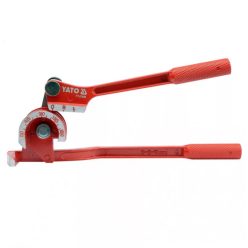

Brake Line Tools: Cleaner Preparation, More Reliable Connections
These workshop tools for brake pipes and fittings are often searched as brake line tooling, built to support clean joint seating through cutting, bending and flaring steps.
In brake line work, accuracy and cleanliness go together: a well-prepped tube end and proper clamping can help the connection seal without forcing threads or distorting the tube, supporting a controlled tightening approach.
Technical background: why cutting, deburring and flaring matter
Cut quality sets the tone for everything after it: a skewed or crushed cut can shift the clamp and make repeatable flaring harder to achieve.
Deburring is more than finish work: the tube’s inner edge and flare face are sensitive, so reducing burrs and deformation supports a cleaner flare face in practice.
- Flare profile: confirm the kit matches the flare type your fitting requires (as listed on the product card).
- Clamp jaws: correct size and surface help reduce tube slip during forming.
- Bend radius: a suitable bender can help prevent kinks in tighter routing.
How to choose the right set
Quick selection guide: start from tube outside diameter (common inch sizes, with mm helpful), tube material and flare type, then use product filters and specs for fast fitment filtering.
- Diameter: check the clamping range (e.g. 3/16”; 1/4”; 4.75 mm; 6 mm).
- Material: copper-nickel, steel and coated tubes can behave differently, so jaw design matters.
- Flare type: the fitting seat “expects” a specific flare shape, so compatibility must be clear.
- Use case: bench work may favour rigidity, while trackside repairs may favour portability.
If you’re expanding your workshop kit beyond brake lines, it can help to keep tool choices consistent across related tasks and categories.
Use, workflow and failure prevention
Work with a clean tube end and clean clamping surfaces: debris between jaw and tube can steer the tube off-centre, so clean prep is worth the minute it takes.
Set tube stick-out using the tool’s stop or gauge (where provided), then form in controlled steps; several short moves can be easier to manage than one heavy pull.
- Cutting: cut square, then verify roundness so the clamp doesn’t pull the tube sideways.
- Deburring: remove inside and outside burrs without over-thinning the tube end.
- Trial fit: hand-start the nut/fitting to feel whether the seat is correct before final tightening.
A common issue is off-centre clamping, incorrect stick-out, or a flare type that doesn’t match the fitting; signs can include a nut that won’t seat smoothly, a visibly angled flare, or a weep under pressure. When that happens, step back to cutting–deburring–clamping checks before re-flaring.
PRO TIP: Keep a short “practice tube” offcut of the same material in the workshop and validate any new setup on it before touching the car’s final line.
FAQ
What is the most common mistake when making or repairing a brake line?
Confirm the flare type matches the fitting, check the tube end for square cut and proper deburr, then hand-start the nut to verify the seat feels correct. If the nut binds early or the flare looks uneven, review clamping alignment and stick-out settings before trying again.
How is a flaring kit different from a simple tube cutter?
A cutter is for a straight, clean cut, while a flaring tool forms the tube end to seal against the fitting seat. Good cutting and deburring make flaring easier and more consistent.
How do I choose the correct tool size?
Measure tube outside diameter (inch is common; mm is also useful) and match it to the clamping range listed on the product card. If you work across multiple vehicles, a wider-range kit may be more practical.
What should I check if I see a slight weep after tightening?
Inspect the flare face for cracks, angle or imprinting, check the fitting seat and threads, and confirm the nut could be started by hand before tightening. The visual condition of the flare often points to the next correction.
Is a tube bender worth having for brake line work?
Yes, it can help reduce kinks and keep routing tidy in tight spaces. Choose a bender matched to tube diameter and allow adequate radius where possible.
