
BMW Suspension Arms in this category include adjustable rear upper and lower control arms, camber and toe links and reinforced trailing arms for street, drift and track use. High-strength steel or aluminium control arms allow precise geometry correction on lowered and widened BMW chassis, from E30–E36–E46 to E9X and F8X M cars. Polyurethane bushes or spherical rose joints sharpen handling and steering response compared with tired factory components while keeping fitment bolt-on to the OEM mounting points.

Net price: 185 €

Net price: 185 €
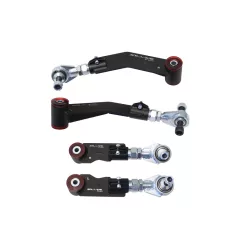
Net price: 321 €
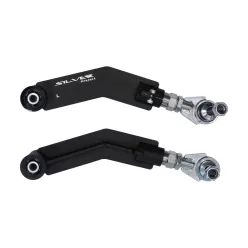
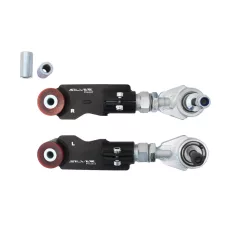
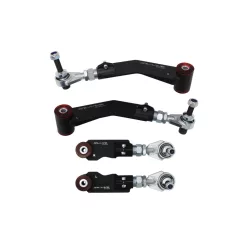
Net price: 321 €
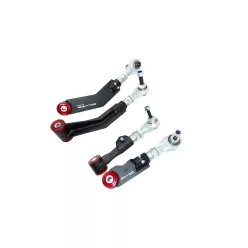
Net price: 321 €
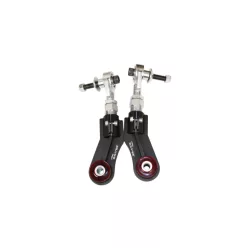
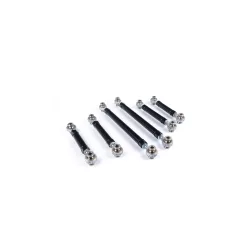
Net price: 612 €
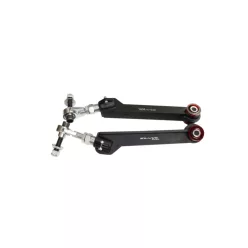
Net price: 185 €
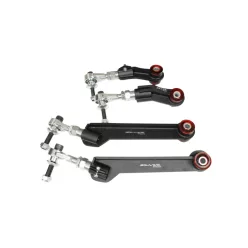
Net price: 349 €
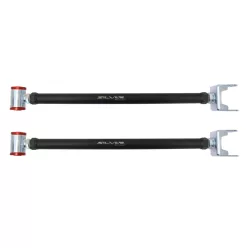
Net price: 148 €
BMW suspension arms for precise geometry control
BMW Suspension Arms are designed to restore or fine-tune wheel alignment on modified and hard-driven BMWs. The range covers adjustable rear camber arms, lower control arm kits, independent toe links and various trailing and longitudinal arms for popular E36, E46, E9X, F-series and M models. By upgrading to stronger, adjustable arms you can dial in the ideal camber and toe for your setup, improving tyre contact, traction and stability on the road, track or drift circuit.
Technical Basics
Most BMW control arms in this category are manufactured from high-tensile steel or forged aluminium, with laser-cut plates, reinforced welds or CNC-machined bodies. Adjustment is provided by threaded turnbuckles, eccentric inserts or extended clevises, allowing a wide range of camber and toe correction beyond the factory slots. Spherical rose joints (uniballs) offer virtually zero compliance and very direct feedback, while polyurethane bushes provide a compromise between stiffness, durability and NVH for fast-road cars.
OEM BMW suspension is typically tuned for comfort and mild understeer, which works well on the street but reaches its limits once ride height is lowered or tyre grip is significantly increased. Lowered cars can gain excessive negative camber and undesirable toe values that cause poor traction and rapid, uneven tyre wear. Adjustable suspension arms solve this by giving you mechanical control over the geometry so you can either restore factory specs or set up more aggressive track or drift alignment safely.
Many arms use larger-diameter hardware, gusseted brackets and thick-wall tubing to withstand the loads generated by slick tyres, drift angles and kerb strikes. Corrosion-resistant coatings – powdercoat or anodising in colours such as blue, black, gold or titanium – protect threads and joints from road salt and debris so that adjustments remain free even after years of use. Some designs also incorporate additional bracing or double-shear mounts to reduce flex under heavy cornering and braking.
Selection Criteria
Choosing the right BMW suspension arm starts with accurate chassis identification: E30, E36, E46, E9X, F30, F80 and so on, plus body style (saloon, coupé, estate), engine and drive layout (RWD or xDrive). Certain arms are specific to M models or particular rear axle types, so checking compatibility lists and OE references is essential before ordering.
You should also be clear about how the car is used. For mainly fast-road driving with a modest drop, adjustable rear camber arms with polyurethane bushes are usually sufficient to correct alignment and sharpen response. For drift, time attack or heavy track work, fully adjustable multi-link kits with spherical joints provide the control needed to keep geometry stable at high loads, though they inevitably increase noise and harshness. Some builds benefit from arms only at the rear, while others – especially dedicated track cars – may require front camber/caster solutions as well.
Wheel and tyre setup is another key factor. Wide wheels with aggressive offsets or spacers, combined with significant lowering, almost always require adjustable camber and toe arms to avoid excessive tyre wear and rubbing. If you plan multiple ride-height or wheel changes, choosing arms with a large and clearly marked adjustment range makes life much easier, allowing you to record and repeat preferred alignment settings for road, track and drift events.
Installation & Maintenance
When installing BMW suspension arms, always inspect the mounting points and rear subframe for cracks or deformation, especially on older E36/E46 platforms known for subframe issues. If damage is present, reinforcement plates or repairs should be carried out before fitting uprated arms. Use new high-grade (10.9 or 12.9) bolts where specified and tighten all fasteners to the recommended torque values.
Threaded adjusters should be lubricated with anti-seize or suitable grease before assembly so that they remain movable after exposure to dirt and road salt. It is good practice to re-check torque and locknuts after the first few hundred kilometres of driving or after the first track session. After any heavy curbing or off-track excursion, inspect arms, brackets and joints for bends, cracks or damaged dust boots.
A full four-wheel alignment is mandatory after fitting any adjustable arms. This is your opportunity to set up a geometry that matches your tyre choice and driving style – whether that means factory-spec street settings, a neutral fast-road setup or a more aggressive track/drift configuration. If you run multiple setups, recording the alignment printouts and noting thread positions on the arms will help you return to known good settings quickly.
FAQ
Why should I fit adjustable suspension arms to my BMW?
Adjustable BMW suspension arms allow you to correct camber and toe on lowered or modified cars so that tyres wear evenly and grip is maximised. They also make it possible to run more aggressive alignment for track or drift without relying on crude factory slots or shims.
Are spherical-joint arms suitable for daily driving?
Spherical-joint rose-jointed arms offer the best precision for motorsport but transmit more noise, vibration and harshness into the cabin. Many people daily-drive cars with these arms, but if comfort is a priority, polyurethane-bushed versions are usually a better compromise.
Do I need an alignment after installing new arms?
Yes, any time you replace or adjust suspension arms you must have a full four-wheel alignment performed. Without this, the car may feel unstable, tyres can wear rapidly and braking performance may suffer, especially in emergency situations.
Will adjustable arms pass roadworthiness or inspection tests?
Quality aftermarket control arms that are correctly installed and free from play, noise or damage generally pass inspection without issue. However, very extreme alignment settings or visibly compromised bushings/joints can cause a fail, so it is wise to use street-friendly settings for formal tests.
How often should I check my adjustable arms?
For track or drift cars, it is sensible to inspect all arms and joints after each event. For mainly road-driven cars, checking them at every service or tyre change – roughly every 10–15,000 km – is usually sufficient, provided no unusual noises or handling issues appear in the meantime.
