
Audi – MTS Technik Suspension Kits provide vehicle-specific, height-adjustable spring–damper sets for daily and spirited driving. Threaded adjusters deliver precise ride-height control, while matched damping improves cornering stability and braking attitude. When selecting, confirm axle loads, body style and the approved adjustment range (quattro vs. FWD differences).

Net price: 618 €

Net price: 631 €

Net price: 631 €

Net price: 607 €

Net price: 605 €

Net price: 802 €

Net price: 773 €

Net price: 663 €
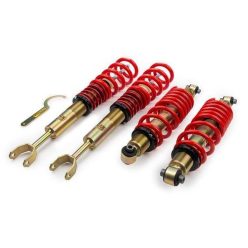
Net price: 684 €
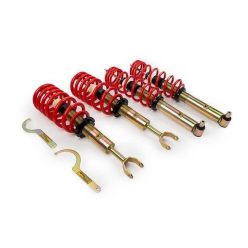
Net price: 663 €
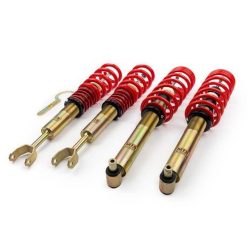
Net price: 663 €

Net price: 663 €
Brief summary & key benefits
Audi – MTS Technik kits sharpen handling while preserving daily usability. A sensible drop lowers the centre of gravity, reducing pitch/roll and improving steering precision. Vehicle-specific tuning and robust anti-corrosion finishes support consistent performance across seasons.
Technical Basics
Each kit pairs tailored steel springs with gas-charged dampers. A threaded body with locking collars enables precise per-axle ride-height changes within the stated range. Depending on application, spring behaviour can be linear (direct feedback) or dual-rate/progressive for improved small-bump compliance. Heat-stable oil, reliable seals and dust boots maintain damping consistency; outer surfaces use corrosion-resistant coatings.
Correct selection depends on axle loads, body style and drivetrain (quattro vs. FWD). Exceeding the approved drop reduces bump travel and can push alignment beyond its useful window. Where available, camber plates allow fine camber tuning to balance front grip, tyre wear and straight-line stability.
Selection Criteria
Use case — For road-biased builds start near mid-range height to preserve travel and alignment; for occasional track days a slightly lower stance is acceptable if clearance remains safe.
Loads & drivetrain — Always match the kit to the exact body/engine/drivetrain combination (quattro/FWD); different axle loads require different spring rates and damping windows.
Geometry — After lowering, perform a full four-wheel alignment (camber/toe/caster). Excessive negative camber accelerates inner tyre wear; camber plates help fine-tune it.
Wheels/tyres — Larger wheels and low-profile tyres increase the risk of bottoming; adapt ride height and check bump stops accordingly.
Installation & Maintenance
Have a qualified shop fit the kit. Replace worn top mounts, check dust boots and bump stops. Clean threads and apply light anti-seize so later adjustments are easy. Torque fasteners to spec and preload rubber bushes at ride height. After a shakedown, re-torque and align.
For longevity, periodically wash threads, refresh anti-corrosion spray and verify that lock collars remain secure. Any knocking, oil traces or harsh pogoing warrants immediate inspection of dampers and mounting points.
FAQ
Q: How low can I go safely?
A: Stay within the manufacturer’s approved range to preserve travel and geometry.
Q: Is alignment required after installation?
A: Yes — lowering alters geometry; set camber/toe/caster correctly.
Q: What baseline settings should I start with?
A: Begin at mid-range height and the recommended damping baseline; fine-tune in small steps.
Q: Are cold-weather noises normal?
A: Slight NVH increases are common with firmer bushings; persistent knocking needs checking.
Q: Do I need adjustable top mounts?
A: They are useful for precise camber control in spirited or track use (where available for your model).
