
In Aeromotive Fuel Pressure Regulators, you can choose adjustable regulators for EFI and carburetted setups, including universal units and vehicle-specific billet options.
Product details commonly show ORB-06/ORB-10 porting, a 1/8 NPT gauge port, and on selected models 3/8" NPT in/out with interchangeable springs for different pressure ranges. Use filters and sorting, open the product card to confirm the exact port layout, then pick the regulator that matches your fuel system.
Add the right unit to your cart and check out.

Net price: 260 €

Net price: 526 €

Net price: 305 €

Net price: 305 €
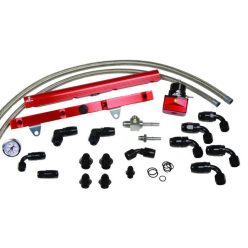
Net price: 1 702 €
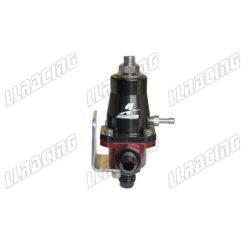
Net price: 288 €
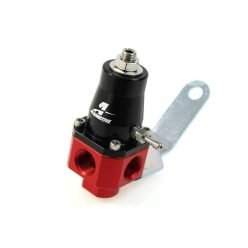
Net price: 354 €

Net price: 268 €
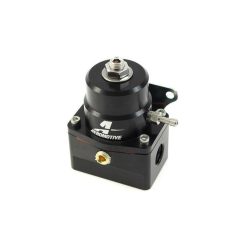
Net price: 268 €
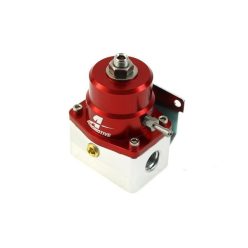
Net price: 294 €

Net price: 280 €
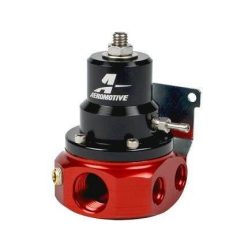
Net price: 398 €
Aeromotive Fuel Pressure Regulators – adjustable base pressure, stable delivery and return-style control for performance builds
A fuel pressure regulator (FPR) is used to hold a consistent base pressure for the engine, while managing excess fuel through the return line in a controlled way.
This Aeromotive selection includes universal “1000HP” regulators, A1000 carburetted (carbureted) options and A2000 bypass regulators, plus several vehicle-specific billet regulators and kits (LT1, Corvette, Ford applications). Always rely on the specific product-page specification for fitment and porting.
Technical Basics
Most setups you’ll see here follow either a bypass (return-controlled) approach or a configuration where overall behaviour depends strongly on pump flow and line restriction. With bypass regulators, a free-flowing return line is critical, otherwise low-pressure control can become unstable.
For boosted engines, look for boost reference capability: some Aeromotive descriptions explicitly state that fuel pressure rises at a 1:1 ratio when referencing boost. That helps maintain predictable differential pressure across injectors under load.
Port standards matter: ORB (O-ring boss) ports such as ORB-06, ORB-08 and ORB-10 seal on an O-ring, not on the threads. You’ll also see a 1/8 NPT gauge port on several models, and selected universal regulators list 3/8" NPT in/out—NPT uses tapered-thread sealing rules.
Pressure ranges vary by model: one universal “1000HP” listing notes two modes via interchangeable springs at 0.2–1.4 bar and 1.4–4 bar, while an ORB-ported 1000HP example lists 2–4.8 bar adjustment and a 1/8 NPT gauge port. Some bypass descriptions even specify return sizing (for example requiring an AN-10 return line) for stable control.
Selection Criteria
Start with your application: EFI systems typically target bar-level base pressure, while carburetted use-cases often quote PSI ranges (for example 3–15 PSI, roughly 0.21–1.03 bar). If you run a blow-through setup, confirm boost reference support on the product page.
Next, match porting to your plumbing: check whether you need ORB-06/ORB-10 or 3/8" NPT in/out, and whether a 1/8 NPT gauge port is required for your sensor or mechanical gauge. With ORB ports, the O-ring condition is a key reliability factor, and AN plumbing usually means using the correct ORB-to-AN fittings.
Don’t ignore the return path: several bypass-oriented notes highlight that EFI conversions may need a larger-than-stock return line, and an A2000 bypass description explicitly calls out an AN-10 return requirement. A restricted return is a common cause of pressure creep and unstable regulation.
Finally, decide on universal vs vehicle-specific: universal parts are chosen by pressure window and port layout (for example AM-13301 with 3/8" NPT in/out and spring-based modes), while billet/kit items depend on confirmed fitment. Use the part number and the product-page details as your final checklist.
Installation & Maintenance
Depressurise the fuel system before work, and perform a thorough leak check after the first start. Set pressure only when you can read a stable value from your gauge or sensor.
With ORB ports, sealing comes from the O-ring, so keep sealing faces clean and avoid treating it like tapered-thread sealing. For a 1/8 NPT gauge port, use proper NPT sealing practice, but avoid excessive sealant that could migrate into the system.
On bypass regulators, verify that the return line is genuinely free-flowing with no hidden restrictions, tight bends or undersized sections. If the description specifies an AN-10 return, treat that as a functional requirement for stable control rather than a suggestion.
For ongoing reliability, periodically inspect fittings, hose ends and mounting points—heat cycles can loosen connections. Warning signs include fuel smell, damp fittings, or logged fuel pressure oscillation under load.
FAQ
Which Aeromotive regulator should I use for EFI vs carburetted?
EFI builds usually target higher base pressure values, while carburetted applications often list PSI ranges (such as 3–15 PSI). Check whether the regulator is bypass style and whether it supports boost reference if you run boost. Use the product page specification as the deciding factor.
What do ORB-06 and ORB-10 ports mean?
ORB ports seal with an O-ring, not with the thread taper, so correct O-ring condition and clean sealing faces are essential. If you use AN hoses, you’ll typically install appropriate ORB-to-AN fittings. Confirm the exact size (ORB-06, ORB-10) on the product page.
What is the 1/8 NPT gauge port for?
A 1/8 NPT gauge port lets you mount a gauge or pressure sensor close to the regulator for accurate setup and troubleshooting. Because NPT is tapered, correct sealing practice matters to prevent leaks. Also confirm sensor clearance and heat exposure in your chosen location.
Why does a bypass regulator need a large return line?
A bypass regulator controls pressure by bleeding excess fuel through the return line, so restrictions directly reduce stability at low pressure. Some descriptions specify return sizing (for example an AN-10 return requirement) to ensure proper control. An undersized return commonly leads to pressure creep and unstable readings.
How do I set base pressure safely?
Confirm port layout (e.g. 3/8" NPT or ORB-06) and connect a reliable gauge, ideally via a 1/8 NPT gauge port if provided. After a leak check, adjust in small steps and verify stability at idle and under load. If you use boost reference, check the reference hose routing and sealing as well.
Once your pressure window, porting and return capacity are confirmed, choose the right Aeromotive regulator and place your order.
