
In 45° AN Elbow Fittings, you’ll find AN 37° flare fittings that let you turn a line by 45° to reduce hose stress and make routing easier in fuel and oil systems.
Common options include AN3–AN12 sizes and NPT 1/8–3/4 threads, but always confirm the exact pairing on the product page. Use filters and sorting to narrow by size/thread, open the item for full specs, then add the right variant to your basket.

Net price: 15 €

Net price: 17 €
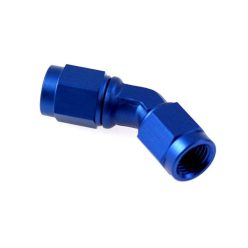
Net price: 8 €
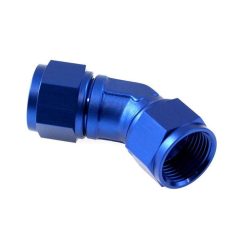
Net price: 10 €
Net price: 11 €
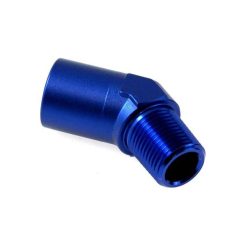
Net price: 8 €
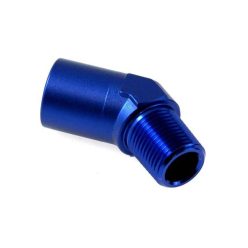
Net price: 6 €
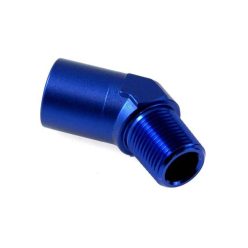
Net price: 6 €
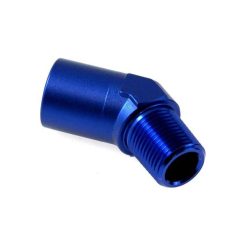
Net price: 7 €
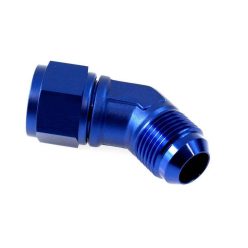
Net price: 15 €
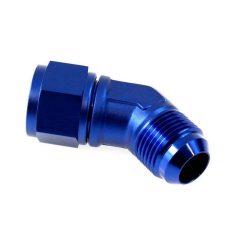
Net price: 17 €
45° AN Elbow Fittings – cleaner routing, less hose strain, compact direction changes
45° AN Elbow Fittings are ideal when you need a gentle change of direction but a 90° elbow would create a sharper bend, extra packaging issues, or unnecessary restriction. A 37° AN connection seals on the flare cone, so the thread’s job is clamping rather than sealing, which makes the joint repeatable when matched correctly. Typical use includes fuel and oil lines, oil coolers, turbo oil feeds/returns, and threaded adapter work around sensors and distribution blocks.
Technical Basics
AN 37° fittings seal on the cone surfaces, not on the thread, so cone condition and standard compatibility matter most. Dash sizing is tied to nominal hose ID; for example AN-6 is commonly associated with about 3/8" ID, while AN-8 is often chosen where higher flow is needed. Many 45° items act as a “union/nipple” style connector, so check both ends (female–female, female–male) as well as the dash size.
NPT is a tapered thread that typically seals via thread interference, which is why PTFE tape or sealant is often used—only where the manufacturer recommends it. If the port uses an O-ring style seal (such as ORB), the sealing element is the O-ring rather than thread force, so over-tightening can do more harm than good. The 1/8–3/4 NPT range is commonly used for sensor ports and threaded engine/oil system interfaces.
Warning: don’t mix 37° AN/JIC flare parts with 45° SAE flare systems, as they can seem to “fit” but will leak and damage the cones. If you’re unsure, verify the port type (thread form, sealing method, cone angle) and match the correct adapter. Materials are often anodised aluminium in motorsport-style fittings, but always follow the exact product specification for heat, pressure, and fluid compatibility.
Selection Criteria
Start with the hose: choose AN-4, AN-6, AN-8, etc. based on the hose type/ID and the flow you need, because undersizing can cause restriction while oversizing adds bulk and can complicate routing. A 45° elbow helps maintain a healthier bend radius and can reduce the need to “force” a hose into position. If packaging is extremely tight, you may still need a 90° elbow or a swivel-style solution, but the space envelope should decide.
Thread matching is the next checkpoint: confirm whether the port expects AN flare, NPT tapered thread, or another sealing approach. It’s common to run AN on the hose side and a threaded adapter on the component side (for example NPT into a block or sensor take-off). Every extra part—reducers, unions, T-pieces, blanking plugs—adds potential leak points, so aim for the simplest chain that achieves the route.
Design details such as fixed vs swivel, wrench access, and how the elbow sits relative to nearby components can be more important than the angle alone. In fuel and oil systems, vibration and heat make proper hose support and strain relief essential. If you plan to run E85 or other aggressive fluids, rely on the manufacturer’s compatibility data for seals and materials.
Installation & Maintenance
Preparation matters: clean threads and flare cones before assembly, because a small particle can create a leak path. On AN flare joints, a light film of oil on the cone can help prevent galling and make tightening smoother. On NPT ends, apply sealant only as specified and keep it out of the flow path.
Tightening should be controlled rather than brute force: over-tightening an AN flare can deform cones and nuts and still leave you chasing leaks. Use proper spanners and ensure the 45° elbow orientation doesn’t preload the hose. After the first heat cycle, recheck joints for any weeping and confirm the hose hasn’t shifted into contact with hot/sharp edges.
Inspection is straightforward: look for a dry joint and trace any film back to the first wet point. If a system is repeatedly disassembled, inspect flare cones for scoring and replace the damaged part rather than tightening harder. Periodic checks are especially important near turbo heat and high-vibration mounting points.
FAQ
What’s the difference between AN and NPT?
AN 37° seals on the flare cone and the thread clamps, while NPT seals through tapered thread interference. That’s why AN relies on cone condition and matching standards, whereas NPT often relies on appropriate thread sealing where specified. Always confirm what sealing method the port is designed for.
How do I choose between AN-6 and AN-8?
Base it on hose ID and required flow: AN-6 is common for many oil and coolant branches, while AN-8 is often used where higher volume is needed. Too small can create restriction; too large adds bulk and can be harder to route. Check the hose and component specifications before committing.
When is a 45° elbow better than a 90°?
A 45° elbow is best for gentle direction changes that reduce hose strain and help preserve bend radius. A 90° elbow can be necessary in tight packaging but may increase space demand and stress if the hose is forced into position. Mock up the route and choose the smallest angle that achieves a relaxed hose path.
Should I use PTFE tape on AN fittings?
Usually not on AN flare joints, because sealing happens at the cone, not the thread. On NPT threaded ends, PTFE tape or sealant is commonly used when the manufacturer specifies it, because the thread is part of the seal. If the port seals with an O-ring, focus on the O-ring condition instead.
Are these fittings suitable for fuel, oil and coolant?
They’re often used across fuel, oil and coolant routing, but true compatibility depends on material and seal type. For E85, high heat, or specialised fluids, follow the manufacturer’s compatibility notes for seals and finishes. If in doubt, pick a fitting explicitly specified for your intended fluid and temperature range.
Filter by the right size and thread, then order the 45° elbow fitting that matches your setup.
